Start with the edges of several mature stem segments: pointed or hooked projections favor Thanksgiving cactus, while smoother, rounded scallops favor Christmas cactus. If the segments are very rounded and show small bristles, keep Easter cactus in the comparison. Flower direction and anther color can strengthen an identification, but bloom month and store labels are weaker evidence because commercial plants may be forced into flower or sold under broad seasonal names. ([extension.illinois.edu](https://extension.illinois.edu/blogs/good-growing/2022-12-09-how-identify-and-care-holiday-cacti-and-get-them-rebloom?utm_source=openai))
The quick three-way identification key
Choose three to five mature, undamaged stem segments from different branches and compare their side margins. These flattened green structures are stems rather than true leaves.
- Sharp, pointed, or backward-curving projections: Thanksgiving cactus, Schlumbergera truncata, is the leading match.
- Rounded, softly scalloped margins: Christmas cactus, commonly identified horticulturally as Schlumbergera × buckleyi, is the stronger match.
- Very rounded margins, sometimes with fine bristles at the segment tips: consider Easter cactus, Rhipsalidopsis gaertneri, which some sources list under Hatiora.
If the margins look intermediate, avoid forcing a species-level answer. Record it provisionally as a holiday cactus and seek flowers or clearer photographs for confirmation. Botanical and horticultural naming may differ among references, especially for Christmas and Easter cacti. ([extensiongardener.ces.ncsu.edu](https://extensiongardener.ces.ncsu.edu/news/holiday-cacti-whats-the-difference/?utm_source=openai))
Thanksgiving vs. Christmas cactus stem segments
Thanksgiving cactus: Look for two to four conspicuous teeth or projections along each side of a segment. They may resemble crab claws, hooks, or small pointed wings. Check several segments because damage, age, and camera angle can make one edge misleading.
Christmas cactus: The segment outline is generally smoother, with broad, rounded scallops rather than distinct points. A flat, face-on view is more useful than a side view because curling or overlapping branches can hide the margins.
Easter cactus: Its segments can also be rounded, so it may initially resemble Christmas cactus. Fine bristles near the segment ends or areoles support the Easter-cactus branch, although a flower provides a clearer distinction. ([extensiongardener.ces.ncsu.edu](https://extensiongardener.ces.ncsu.edu/news/holiday-cacti-whats-the-difference/?utm_source=openai))
Use flower direction and anther color as confirmation
When the plant is flowering, compare the blossom with the stem-based result rather than replacing it.
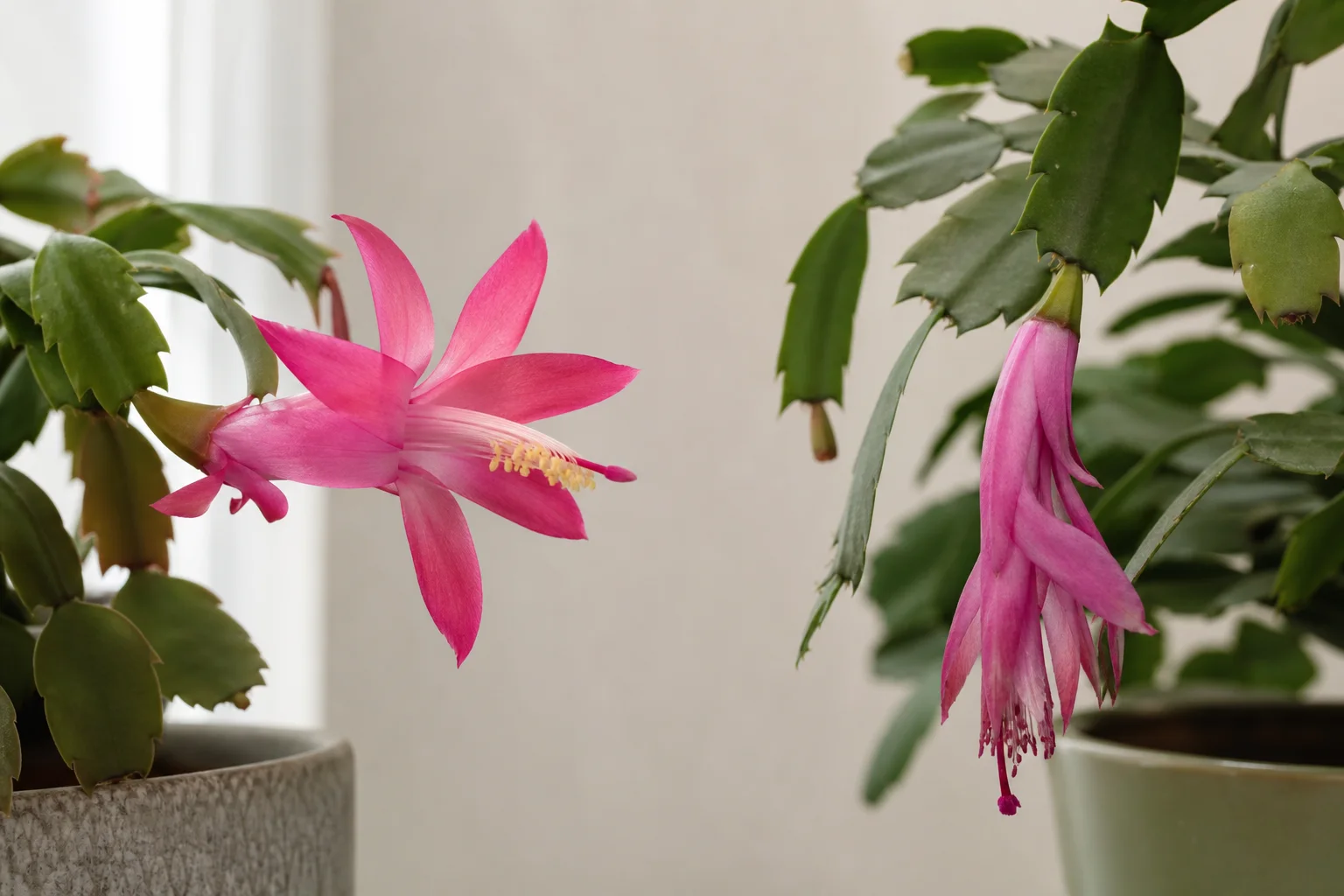
- Thanksgiving cactus: Tubular, asymmetrical flowers commonly project outward or more horizontally. The pollen-bearing anthers are generally yellow.
- Christmas cactus: Tubular flowers tend to hang more noticeably downward. The anthers are commonly pinkish-purple to purplish-brown.
- Easter cactus: Flowers are flatter and more radially arranged, producing a star-like appearance rather than the layered, directional tube associated with the other two.
Photograph both the side of the flower and its center. Petal color alone is not a useful separator because holiday cacti are sold in overlapping shades, including pink, red, orange, white, and purple. Flower orientation can also vary with branch position, so combine it with segment shape and anther color. ([extension.illinois.edu](https://extension.illinois.edu/blogs/good-growing/2022-12-09-how-identify-and-care-holiday-cacti-and-get-them-rebloom?utm_source=openai))
Why store labels and bloom months can mislead
Many plants marketed under the familiar name “Christmas cactus” are Thanksgiving cacti or modern cultivars with Schlumbergera truncata traits. Thanksgiving cactus is widely available during the winter shopping season, so a December purchase date does not establish the plant's identity. ([extension.illinois.edu](https://extension.illinois.edu/blogs/good-growing/2022-12-09-how-identify-and-care-holiday-cacti-and-get-them-rebloom?utm_source=openai))
Natural flowering periods provide context, but growers can manipulate temperature and uninterrupted darkness to prepare plants for a retail window. Conditions in the home may also shift flowering from one year to another. Treat the month of bloom as supporting information, not the deciding feature.
Keep the original tag because a cultivar name may still be useful. Photograph it separately, then compare the plant's physical traits without assuming the seasonal common name is botanically precise.
Set an honest confidence level
Higher-confidence identification
Several undamaged segments repeatedly show the same margin shape, and an open flower has a matching orientation, form, and anther color.
Moderate-confidence identification
The plant is not blooming, but multiple mature segments clearly show either pointed projections or rounded scallops. Use “likely Thanksgiving cactus” or “likely Christmas cactus” until flowering provides another comparison point.
Lower-confidence identification
The conclusion depends on a store label, bloom month, petal color, one damaged segment, or a blurry photograph. Intermediate traits may also occur in cultivated plants, making a broad identification such as Schlumbergera holiday cactus more appropriate.
If rounded segments could fit either Christmas or Easter cactus, inspect for bristles and wait for flower shape. A flat, star-like flower supports Easter cactus; a directional tubular flower supports the Thanksgiving-or-Christmas branch. ([extensiongardener.ces.ncsu.edu](https://extensiongardener.ces.ncsu.edu/news/holiday-cacti-whats-the-difference/?utm_source=openai))
Take photos that show diagnostic features
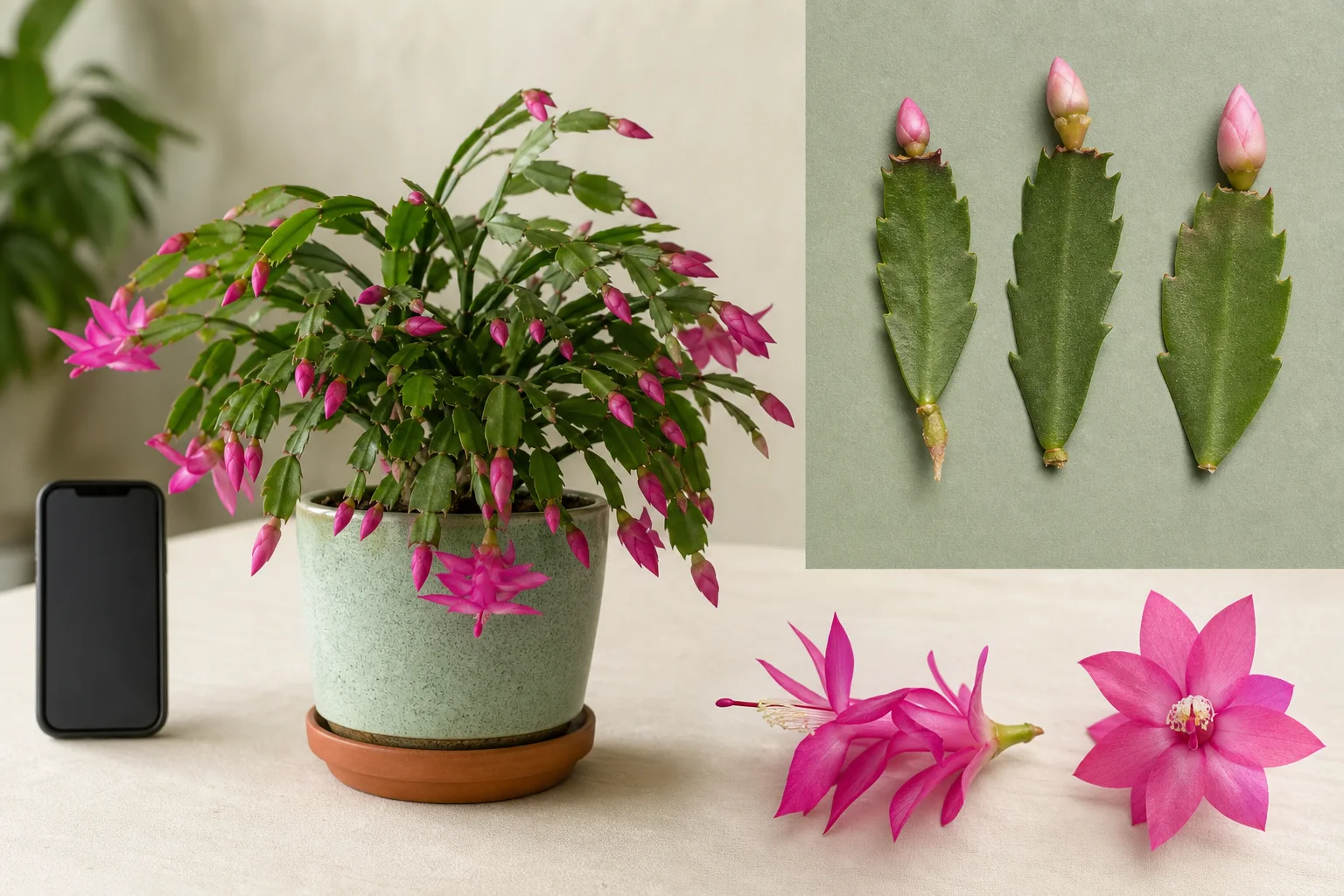
A useful image set shows both the overall growth habit and the small details used in the comparison. Do not remove a healthy segment from a valued plant solely for identification; a supported segment can usually be photographed while attached.
- Take one photo of the entire plant, including the pot and the way its branches arch or hang.
- Hold or support one mature segment against a plain, contrasting background so it lies as flat as practical.
- Focus on the segment margins and tip. Include several connected segments if possible.
- If flowers are present, photograph one from the side to show its direction and one from the front to show the anthers.
- Use bright, diffuse daylight, avoid color filters, and check that the edges are sharp before submitting the images.
- Photograph the retail tag separately, including any cultivar or botanical name.
A photograph can support an identification, but hidden features, hybrids, damage, and poor focus may limit confidence. Submit multiple views rather than relying on a single whole-plant image.
Which name should you use?
If the plant is not blooming: Base your provisional choice on repeated segment-margin shape. Pointed projections favor Thanksgiving cactus; rounded scallops favor Christmas cactus.
If the plant is blooming: Start with the stems, then use flower direction and anther color as confirmation. Redirect the comparison toward Easter cactus if the bloom is flat and star-like.
If you are shopping: Examine the plant rather than relying on the front of the tag. A label containing a botanical or cultivar name may be more informative than a generic seasonal label, but visible traits still deserve comparison.
If traits remain mixed: “Holiday cactus” or “Schlumbergera hybrid” is a practical description. A cautious broad name is more useful than a narrow identification based on weak evidence.
Recommendation: For a non-blooming plant, prioritize stem edges. For a blooming plant, require the stems and flowers to tell a consistent story. Keep Easter cactus as a genuine third option instead of treating every rounded segment as Christmas cactus.
Identify Your Holiday Cactus From Better Photos
Upload a full-plant image and a flat, in-focus close-up of several connected stem segments. Add side and center views of an open flower when available so the identification can compare multiple traits.
Identify My PlantFrequently Asked Questions
Are Thanksgiving cactus and Christmas cactus the same plant?
They are closely related holiday cacti, but the names usually refer to different botanical backgrounds. Thanksgiving cactus is Schlumbergera truncata, while the traditional Christmas cactus is commonly identified as Schlumbergera × buckleyi. Retailers may use “Christmas cactus” broadly, so inspect the stem margins before relying on the tag. ([site.extension.uga.edu](https://site.extension.uga.edu/paulding/2022/12/christmas-or-thanksgiving-cactus/?utm_source=openai))
Can I identify my holiday cactus by when it blooms?
Bloom time is supporting evidence rather than a decisive test. Greenhouse scheduling, indoor light, and temperature can shift flowering, and Thanksgiving cacti are commonly prepared for the Christmas retail season. Stem-segment shape is more useful when the plant is not flowering. ([extension.illinois.edu](https://extension.illinois.edu/blogs/good-growing/2022-12-09-how-identify-and-care-holiday-cacti-and-get-them-rebloom?utm_source=openai))
How can I distinguish Christmas cactus from Easter cactus without flowers?
Both can have rounded segment margins. Easter cactus segments are often very rounded and may show fine bristles at the tips or areoles, while Christmas cactus commonly has broader scalloped margins without the same bristly appearance. If the features are unclear, retain both possibilities until the plant flowers. ([extensiongardener.ces.ncsu.edu](https://extensiongardener.ces.ncsu.edu/news/holiday-cacti-whats-the-difference/?utm_source=openai))
Are the pointed edges on a Thanksgiving cactus thorns?
No. The visible points are projections of the flattened stem margin rather than separate cactus spines. Holiday cacti have jointed green stems that are frequently mistaken for leaves.
What flower feature is most useful for Thanksgiving vs. Christmas cactus?
Look at the pollen-bearing anthers in the flower center: they are generally yellow on Thanksgiving cactus and pinkish-purple to purplish-brown on Christmas cactus. Direction also helps—Thanksgiving flowers commonly project outward, while Christmas flowers tend to hang downward—but these features should confirm a stem-based identification. ([hgic.clemson.edu](https://hgic.clemson.edu/holiday-cactus-2/?utm_source=openai))
Can a plant-identification photo settle the comparison?
Clear photographs may support a strong identification when they show several mature segment margins and, if available, the side and center of a flower. Confidence should remain lower when the plant has intermediate traits, damaged growth, or only a distant whole-plant photo.
Sources & Further Reading
- Holiday Cacti - What's the Difference? NC State Extension
- Holiday Cacti Penn State Extension Master Gardener Program
- How to Identify and Care for Holiday Cacti and Get Them to Rebloom University of Illinois Extension
- Holiday Cactus Clemson Cooperative Extension Home & Garden Information Center
- Schlumbergera truncata Royal Botanic Gardens, Kew — Plants of the World Online
- Rhipsalidopsis gaertneri Royal Botanic Gardens, Kew — Plants of the World Online