For a short trip, many established houseplants need only a moisture check and thorough watering before departure. For one to two weeks, use a plant-sitter or a tested wick, capillary mat, or existing reservoir system according to each plant’s moisture tolerance; for longer trips, a reliable person should inspect the plants and equipment. Never assume that leaving every pot in standing water is a safe substitute for watering.
First, sort plants by trip length and thirst
Do not give every plant the same vacation treatment. Start by grouping plants according to how their potting mix normally behaves—not simply by their names—and compare that behavior with the length of your absence.
Weekend or short absence
For roughly two to four days, an established plant may need no special system. Check the mix before leaving and water only if the plant has reached its normal watering point. Small pots, unglazed clay pots, root-bound plants, and plants near hot, bright windows can dry faster and deserve closer attention.
About five days to two weeks
Use a sitter for plants that dry quickly or have little margin for error. A tested wick, capillary mat, or established self-watering reservoir may suit plants that prefer relatively even moisture. Plants that normally complete a pronounced dry cycle may be safer without continuous water.
Longer than two weeks
Make a plant-sitter the default, especially for large, valuable, newly acquired, flowering, or pest-prone collections. Passive systems can run dry, lose contact, leak, or supply too much water, so a person should inspect both the plants and the equipment.
Assign each plant a moisture group
- Even-moisture plants: Plants such as many ferns, fittonias, and African violets may be candidates for a tested wick or mat if their pots and substrates are compatible.
- Moderate dry-down plants: Common tropical foliage plants may tolerate a short absence after normal watering, but longer trips usually call for a sitter or carefully calibrated system.
- Dry-cycle plants: Cacti, many succulents, ZZ plants, snake plants, many hoyas, and orchids in coarse bark should not automatically be connected to continuous moisture.
Do not park dry-cycle plants, recently repotted plants, or pots with poorly draining mix in standing water. Roots need air as well as moisture, and saturated substrate can remain wet long after the plant has taken what it needs.
Gather materials and start before departure day
Your setup should complete at least one realistic trial before the trip. Begin early enough to observe the plant through its usual dry-down period; for many households, starting seven to ten days ahead provides more useful information than a last-minute test.
Useful materials
- A list or current photo of every plant
- Waterproof labels or numbered markers
- A finger, wooden skewer, or other familiar method for checking substrate moisture
- Premeasured watering bottles or a marked watering can for a sitter
- Clean synthetic capillary matting or suitable wicking cord
- Stable, leakproof reservoirs with covers where practical
- Waterproof trays that are larger than the pots or mat
- Towels for testing leaks—not for leaving beneath an untested system
Check the pots before choosing a method
Confirm that drainage holes are open and identify whether each plant is in a nursery pot inside a decorative cachepot. A cachepot can conceal drained water, so the inner pot must be lifted and the outer container emptied after top watering. For capillary mats, the potting mix must be able to contact the wet mat through unobstructed drainage holes.
Do not repot a plant solely to install a reservoir immediately before leaving. Repotting changes how quickly the substrate dries, while damaged or disturbed roots may respond unpredictably to continuous moisture.
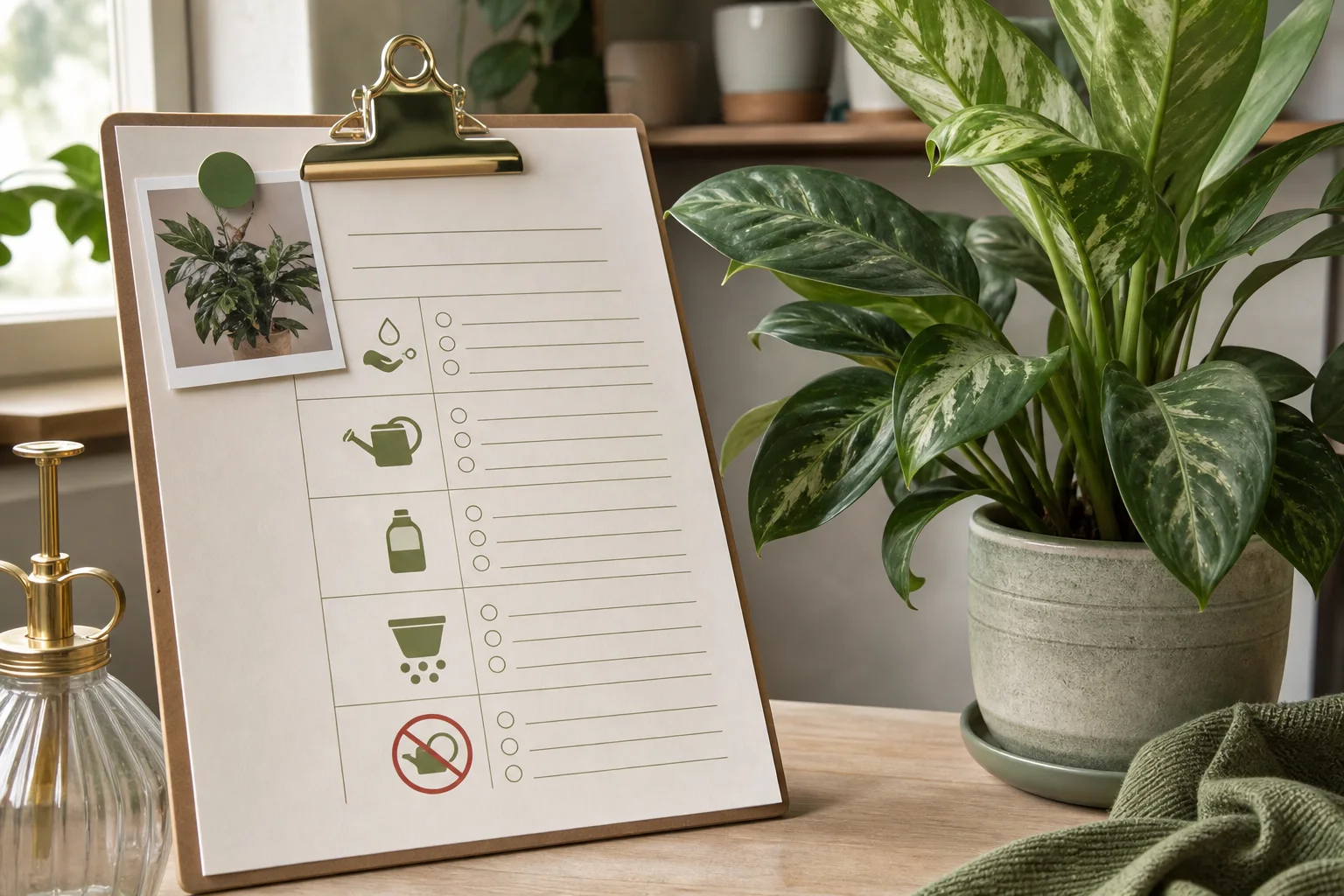
Create a one-page card for your plant-sitter
A plant-sitter is only as effective as the instructions they receive. Replace vague directions such as “water once a week” with an observable moisture check, a plant-specific method, and a clear stopping point.
Copy this card for each plant or watering group
PLANT PHOTO: Attach a current photo
PLANT NAME OR NUMBER: ____________________
LOCATION: ____________________
CHECK MOISTURE: Insert a finger or wooden skewer to ______ depth. Water only when ____________________.
AMOUNT AND METHOD: Use the bottle marked ______. Pour slowly over the substrate until ____________________.
AFTER WATERING: Allow drainage, then empty the saucer or cachepot.
DO NOT: ____________________
CHECK AGAIN WHEN: ____________________
CONTACT ME IF: The reservoir leaks, the plant collapses, the substrate smells sour, pests appear, or you are unsure whether it needs water.
Calibrate the instructions yourself
- Wait until the plant reaches its normal watering point.
- Perform the same moisture check the sitter will use.
- Water slowly using a measured container.
- Record approximately how much water evenly moistens the root zone without leaving the pot standing in drainage.
- Photograph the plant and its correct position after watering.
A measured amount is a maximum guide, not permission to pour it onto already-wet substrate. If a plant is difficult to assess, tell the sitter to contact you rather than adding water “just in case.”
Test every wick, mat, or reservoir before relying on it
A trial is essential because water movement depends on the wick material, wick contact, reservoir position, drainage holes, potting mix, pot size, and the plant’s actual water use. A system that works for one pot can leave another dry or saturated.
Trial-run workflow
- Start with a normally hydrated plant. Water as usual and let excess water drain. Do not begin with severely dry, water-repellent substrate.
- Assemble the complete system. Use the same reservoir, wick length, mat area, pot position, light, and room conditions planned for the trip.
- Mark the reservoir level. Record the starting level so you can see how quickly water is moving.
- Check after 24 hours. Look for leaks, a displaced wick, water pooling in a cachepot, or substrate becoming wetter than it normally remains.
- Check again after 48 hours and at the plant’s usual watering interval. Feel below the surface rather than judging by color alone. Inspect the drainage area and smell for stale or sour substrate.
- Adjust one variable at a time. Change wick thickness, wick contact, reservoir height, or the number of wicks; then repeat the observation.
- Calculate usable capacity. Compare water used during the trial with the reservoir volume, leaving a margin for warmer or brighter conditions. Do not treat this calculation as a survival guarantee.
- Run a final leak test. Protect floors and furniture with a rigid waterproof tray, and keep water away from electrical cords and outlets.
What success looks like
The root zone remains within the plant’s normal moisture range, the reservoir level falls gradually, the pot does not sit directly in water, and no runoff accumulates inside a cachepot. If you cannot produce repeatable results, use a sitter instead.
Choose the method that matches the pot and plant
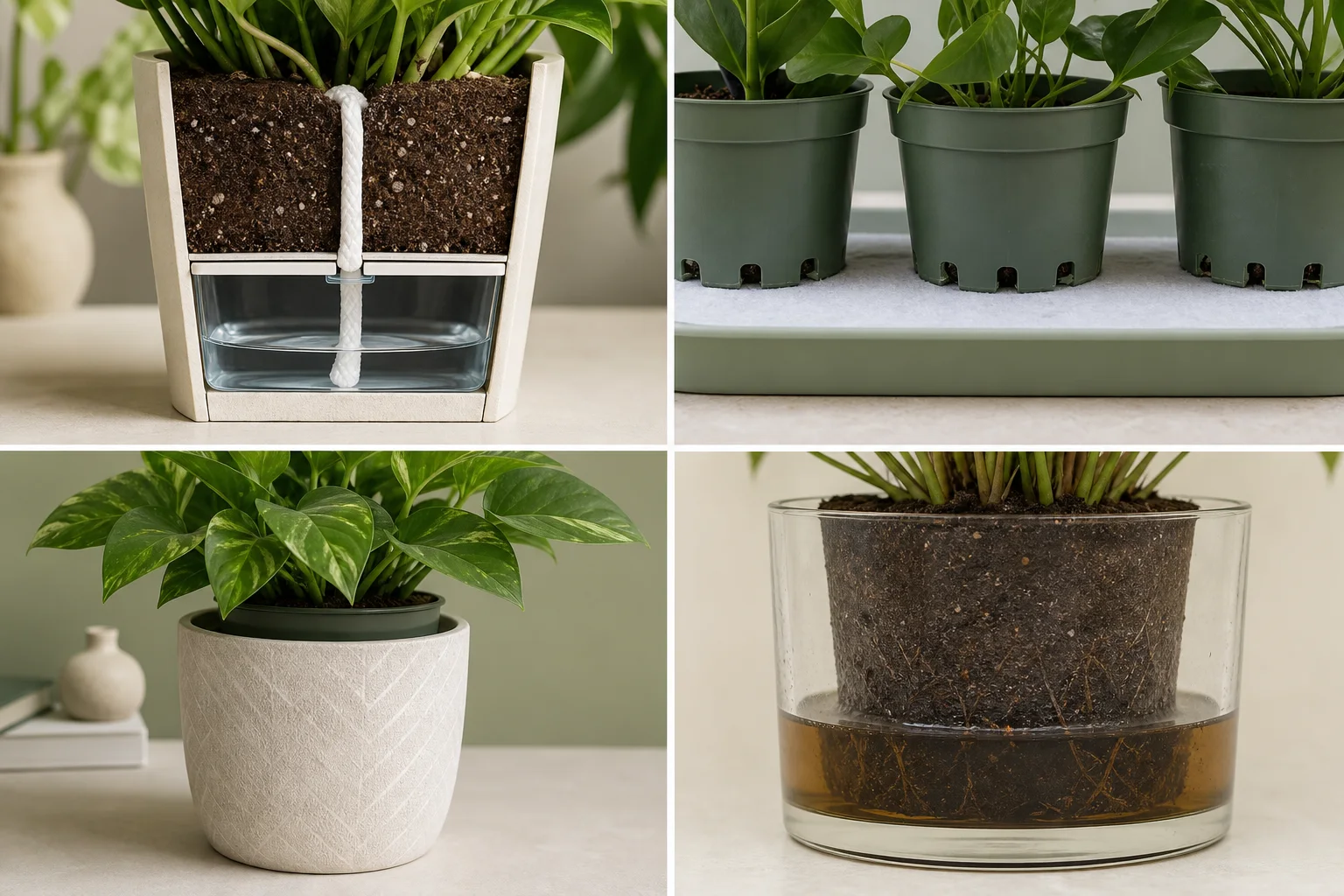
Individual wick and external reservoir
A wick can serve an individual pot when it maintains continuous contact with both the reservoir and the potting mix. Synthetic yarn or purpose-made capillary cord is generally more durable than material that decomposes quickly. Secure the plant end in the root zone rather than laying it loosely on the surface.
Best candidate: A plant that prefers relatively even moisture and performed well during the trial.
Common failure: The wick slips out, dries between the reservoir and pot, or transfers water faster than the substrate can safely hold it.
Capillary mat
A saturated capillary mat can supply several compatible small pots at once. The drainage holes and potting mix must touch the mat; raised pot feet, blocked holes, thick drainage layers, and some pot designs can interrupt water movement. Unglazed clay pots may need to be thoroughly watered before they begin drawing effectively.
Best candidate: A group of pest-free plants with similar moisture requirements in compatible nursery pots.
Common failure: Poor contact leaves one pot dry while another stays too wet. Shared wet surfaces can also make it easier for certain pest or disease problems to move between closely grouped plants.
Built-in self-watering reservoir
Reservoir planters are most dependable when the plant is already established in the system and the substrate has suitable air space. They are better treated as a long-term growing method than as an emergency conversion immediately before travel.
Best candidate: A moisture-loving plant already growing successfully with its reservoir routinely filled and cleaned.
Common failure: The reservoir is overfilled, the aeration gap is lost, or a dry-preferring plant remains continuously wet.
Plants to keep out of standing water
Do not leave ordinary nursery pots submerged in bowls, bathtubs, sinks, or water-filled cachepots. This is especially risky for cacti, succulents, orchids in bark, dry-cycle foliage plants, and any specimen in compacted or poorly draining substrate. A designed reservoir keeps most of the root zone above the stored water and transfers moisture through a wick or capillary column; that is different from immersing the entire pot base.
Reduce water loss without creating new problems
Light, temperature, humidity, pot size, container material, substrate, roots, and season all affect how quickly a houseplant uses water. Make only modest environmental changes, and include those changes in the trial.
- Move plants back from intense direct sun or a hot window: Maintain suitable indirect light rather than putting them in a dark room. A sudden move into darkness can stress the plant and makes moisture use harder to predict.
- Avoid heat sources and drafts: Keep plants away from heating vents, air-conditioner blasts, and frequently opened exterior doors.
- Group compatible, pest-free plants: This can modestly reduce water loss around the foliage, but do not crowd leaves so tightly that air circulation disappears.
- Close blinds selectively: Reduce harsh midday sun while preserving daylight appropriate for the species.
- Pause fertilizer: Do not combine vacation preparation with feeding, repotting, heavy pruning, or another major care change.
- Remove standing drainage: Water plants that need it, let them drain, and empty ordinary saucers and cachepots before departure.
Do not move all houseplants outdoors. Outdoor sun, wind, rain, temperature swings, and pests can change water use dramatically and may cause more damage than the absence itself.
Use final departure and return checks
On departure day
- Check each plant’s substrate and water only those that have reached their normal threshold.
- Confirm that drainage has finished and ordinary cachepots contain no water.
- Fill tested reservoirs to the trialed level—never above the system’s safe fill line.
- Tug gently on every wick and confirm contact at both ends.
- Check that mat-fed pots sit flat with drainage holes touching the wet material.
- Place the watering cards, premeasured water, and contact details where the sitter can find them.
- Photograph the finished setup so you and the sitter have a reference.
When you return
Do not immediately water the entire collection. Check the substrate, pot weight, reservoir, leaves, and drainage area first. A wilted plant may be dry, but wilting can also accompany damaged roots in overly wet substrate.
- If the mix is dry and pulling away from the pot, rehydrate it gradually with repeated slow applications.
- If the mix is saturated, empty reservoirs and cachepots, restore normal drainage, and let the plant move toward its usual moisture range.
- If leaves yellow, stems soften, roots smell unpleasant, or the plant remains collapsed despite moist soil, isolate it from the collection and investigate possible root damage.
- Record what worked, how much reservoir water remained, and which instructions confused the sitter. Use those notes for your next trip.
Final success check: Your plan is ready only when it has worked during a realistic trial, each plant has an observable watering threshold, and a person knows how to respond if the equipment or plant behaves differently than expected.
Make a Vacation Watering Plan
Use the care-plan generator to organize plants by moisture needs, record sitter instructions, and create a one-page checklist before your trial run.
Generate My Watering PlanFrequently Asked Questions
How long can houseplants go without water while I am on vacation?
There is no dependable number that applies to every houseplant. Species, root health, season, light, temperature, humidity, pot size, container material, and substrate all affect drying time. Observe how long each pot normally takes to reach its watering threshold, then choose a plan with an added inspection margin.
Should I water all my plants immediately before leaving?
No. Check each plant first and water only if it has reached its normal moisture threshold. Thoroughly watering an already-wet cactus, succulent, orchid, or other dry-cycle plant can leave its roots saturated for much of the trip.
Can I leave houseplants in a bathtub filled with water?
Do not leave ordinary pots submerged in a standing-water bath. Continuous saturation reduces air around roots and is unsuitable for many houseplants. A capillary mat draped into a separate reservoir is different because the pots rest on the wet material rather than being immersed, but the setup still requires a trial.
Are watering globes reliable for vacations?
Their release rate can vary with the opening, substrate texture, insertion angle, and whether the outlet becomes blocked. Treat a globe like any other unattended watering device: test it through a normal dry-down cycle and use a sitter if the result is inconsistent.
Which plants should not use a vacation wick or reservoir?
Avoid untested continuous-moisture systems for plants that normally dry substantially between waterings, including many cacti, succulents, ZZ plants, snake plants, hoyas, and orchids in coarse bark. Recently repotted plants and specimens in dense, poorly draining substrate are also poor candidates. Individual requirements vary, so use the plant’s established response as the deciding factor.
How often should a plant-sitter visit?
Base visits on the fastest-drying plants and the inspection needs of the equipment, not a universal weekly schedule. During your trial, record when each plant reaches its moisture threshold. For a longer trip, arrange enough visits to catch an empty reservoir, leak, pest outbreak, or unexpectedly dry pot before serious stress develops.
Sources & Further Reading
- Vacation Plant Care University of Florida IFAS Gardening Solutions
- Chapter 14: Houseplants Washington State University Extension
- Houseplants: Holiday Care Tips Royal Horticultural Society
- Watering Houseplants University of Illinois Extension
- Properly Watering Container Houseplants Virginia Cooperative Extension
- How to Care for Houseplants Iowa State University Extension and Outreach