Trees commonly lose leaves as a seasonal adaptation: they recover usable nutrients, seal the leaf attachment, and reduce water loss during cold or dry conditions. If a tree sheds leaves during its normal dormant season, the change may require no intervention. Leaf loss during active growth deserves a closer look at moisture, weather, roots, leaf damage, and the pattern across the canopy.
Why seasonal leaf drop happens
Broad leaves capture light efficiently, but they also release substantial moisture through tiny pores. In climates with cold winters, frozen soil can limit the water available to roots while broad leaves continue losing moisture. Many deciduous trees avoid that imbalance by dismantling and shedding their leaves before winter.
Shortening days provide a dependable seasonal cue in temperate regions, while temperature and moisture influence the timing. Chlorophyll breaks down during leaf senescence, revealing yellow and orange pigments or allowing other colors to develop. The tree may retrieve nitrogen and other reusable compounds from the leaf before separation.
How a leaf detaches
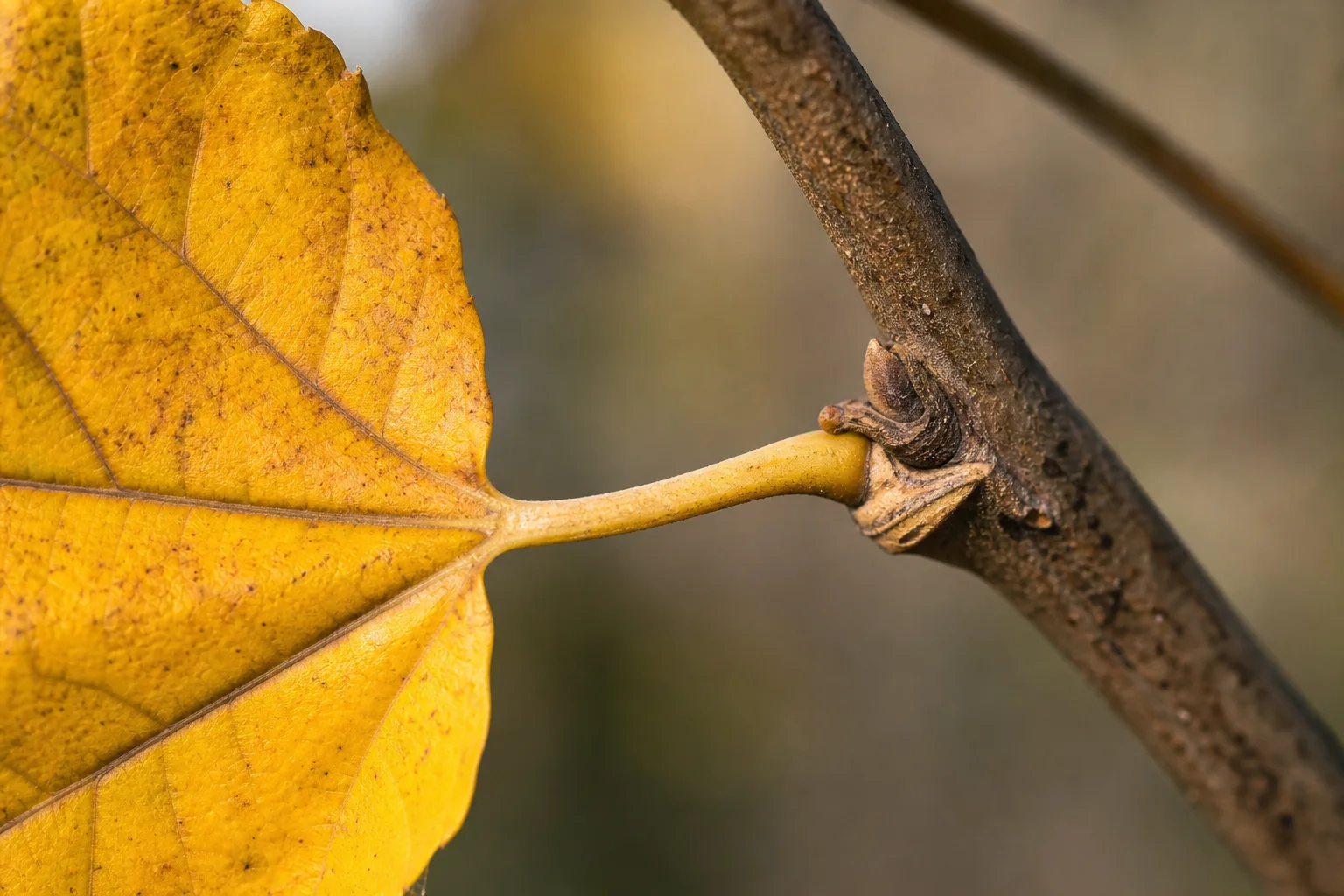
An abscission zone develops where the leaf stalk meets the twig. Cells in this area gradually weaken the connection while a protective seal forms on the twig side. Wind, rain, or gravity can then remove the leaf without leaving the twig as exposed as a fresh tear would.
Know what is normal for the type of tree
Before treating leaf loss as a problem, identify the tree and compare its behavior with the season. Trees use several foliage strategies:
- Temperate deciduous trees: Maples, birches, aspens, and many other broadleaf trees typically shed their canopy in autumn and produce new leaves after dormancy.
- Dry-season deciduous trees: Some trees in tropical, subtropical, and seasonally dry climates shed leaves when rainfall declines rather than when temperatures turn cold.
- Evergreen trees: Pines, spruces, hollies, and other evergreens replace older foliage over time. Yellowing and loss limited to older, inner needles or leaves can be part of this renewal.
- Deciduous conifers: Larch, tamarack, dawn redwood, and bald cypress have needles but shed them seasonally.
- Trees with marcescent leaves: Some oaks, beeches, hornbeams, and related trees may retain dry brown leaves through part of winter. Wind or expanding spring buds usually dislodge them later.
Species identity matters because normal fall behavior for a maple would be unusual for a spruce losing current-year needles from branch tips.
Is the leaf drop seasonal or premature?
Use the pattern, not one fallen leaf, to decide what to investigate. Walk around the entire tree and compare affected branches with healthy ones.
- Check the calendar. Gradual color change near the tree’s usual dormant season suggests normal senescence. Heavy loss during spring or summer is more likely to involve stress, damage, pests, or disease, unless the species is adapted to a dry-season dormancy.
- Look at canopy distribution. Even change across the canopy fits seasonal shedding. One dead branch, one scorched side, or decline near construction work points toward a localized issue.
- Inspect fallen leaves. Cleanly colored leaves differ from leaves covered in spots, holes, sticky residue, distorted growth, browned margins, or fine stippling.
- Review recent conditions. Drought, prolonged saturation, extreme heat, an abrupt freeze, transplanting, excavation, soil compaction, and chemical drift can precede leaf loss.
- Check twigs and buds. Healthy-looking buds and flexible twigs are more encouraging than shriveled buds, spreading dieback, cracked bark, or brittle branch tips.
A single symptom rarely identifies the cause. Record when the loss began and photograph the canopy, leaves, trunk, and surrounding soil so changes can be compared over time.
Check water and soil before reaching for a treatment
Both dry and waterlogged soil can interfere with water movement through a tree. The visible result may be wilting, scorched margins, dull foliage, early color, or premature shedding.
If the soil may be dry
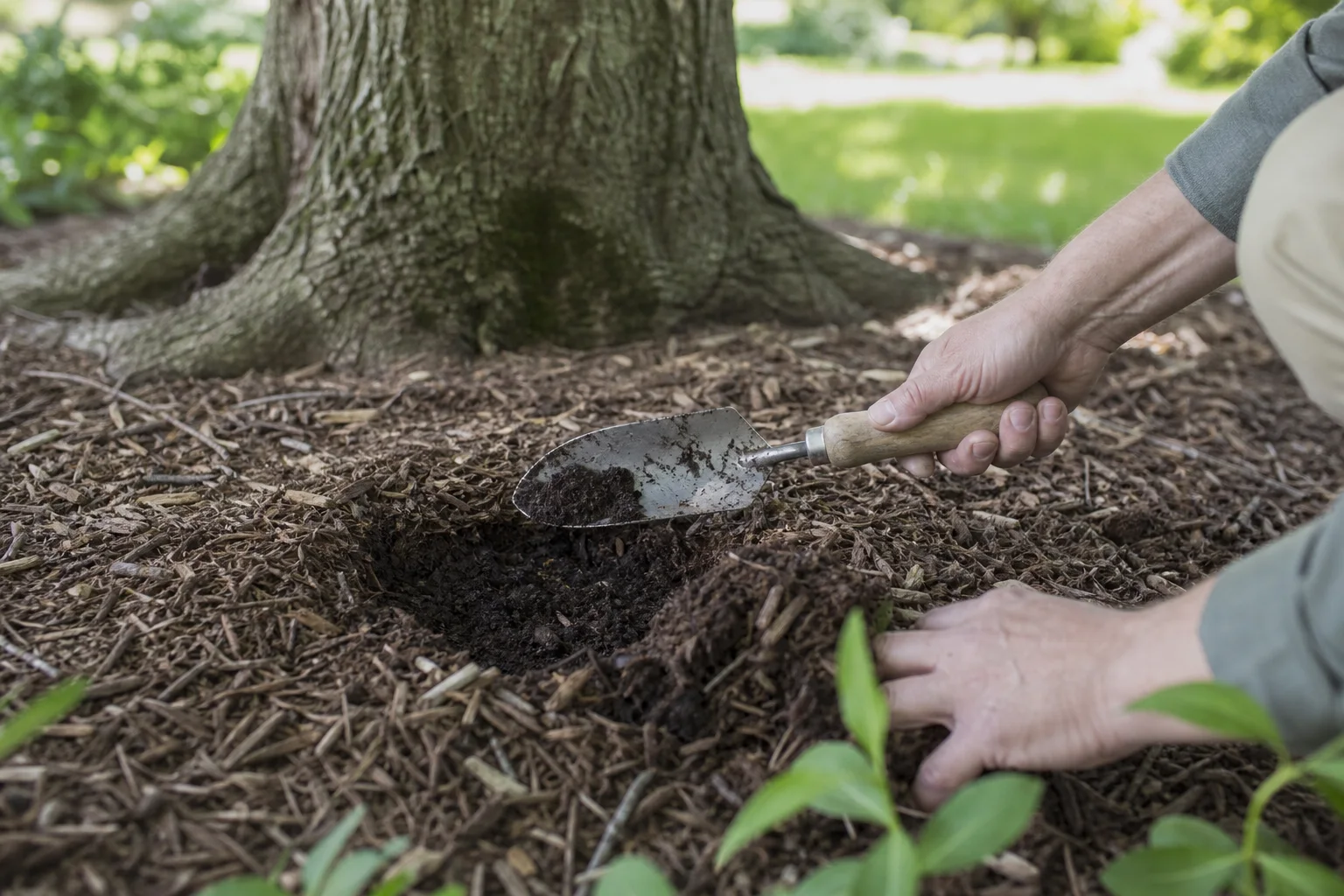
Use a hand trowel to examine soil beneath the canopy without cutting major roots. If the soil is dry several inches down, apply water slowly across a broad portion of the root zone. A deep, measured watering is generally more useful than briefly wetting the soil beside the trunk. Recheck moisture before watering again because clay, loam, and sandy soils dry at different rates.
If the soil remains wet
Pause supplemental watering and investigate drainage, downspout discharge, irrigation leaks, grade changes, or compacted soil. Roots need oxygen as well as moisture, so adding more water to saturated ground may intensify stress.
Protect the root zone
A broad layer of organic mulch can moderate soil temperature and moisture. Keep it several inches away from the trunk and leave the root flare visible. Young, recently planted, and root-disturbed trees often need closer monitoring than established trees.
Other causes of early leaf loss
If moisture does not explain the pattern, inspect the tree for evidence that separates environmental stress from a pest or disease problem.
- Leaf-spot diseases: Numerous tan, brown, black, or purple-edged spots may merge as affected leaves yellow and fall. Wet weather and prolonged leaf moisture can favor several leaf-spot pathogens.
- Feeding insects and mites: Chewed edges, skeletonized tissue, mines, galls, stippling, honeydew, or visible insects provide more useful clues than leaf drop alone.
- Root disturbance: Trenching, paving, grade changes, mower damage, compacted soil, and recent construction can reduce the roots available to support the canopy.
- Trunk or branch injury: Girdling ties, damaged bark, cankers, split limbs, or disrupted water-conducting tissue may produce localized wilting and shedding.
- Weather injury: Heat, drought, flooding, wind, hail, or an untimely freeze can cause abrupt symptoms. Injury may be strongest on the exposed side of the canopy.
- Chemical or salt exposure: Herbicide drift, excessive fertilizer, deicing salt, or contaminated runoff may cause distorted growth, marginal browning, or uneven decline.
Several causes can occur together. For example, drought-stressed trees may be less able to tolerate subsequent insect feeding or disease pressure.
Avoid reflex treatments that can add stress
Premature leaf drop can prompt quick action, but treatment without a cause may waste time or aggravate the tree’s condition.
- Do not fertilize simply because the canopy looks thin. Fertilizer does not repair damaged roots, correct saturated soil, or resolve most leaf diseases.
- Do not apply an insecticide or fungicide until the pest or pathogen has been identified and the treatment timing is appropriate.
- Do not prune living branches solely to compensate for lost leaves. Remove broken or hazardous material, but delay extensive pruning until the tree’s structure and condition have been assessed.
- Do not water by a fixed calendar. Adjust the routine to rainfall, soil texture, drainage, tree age, and measured soil moisture.
- Do not pile mulch against the trunk. A mulch mound can hide the root flare and keep bark persistently damp.
For a large tree, avoid climbing or cutting overhead branches yourself. Work near utility lines, hanging limbs, or major trunk defects should be evaluated by qualified professionals.
Monitor recovery or arrange an inspection
A tree that enters normal dormancy should retain viable buds and show species-appropriate growth when favorable conditions return. After premature shedding, improvement may be gradual and depends on the cause, severity, tree age, and root condition. Track bud development, new dieback, and canopy density rather than expecting fallen leaves to be replaced immediately.
Continue observing when
- Leaf drop aligns with the species and local season.
- Older inner evergreen foliage is shedding while branch tips remain green.
- The canopy has no expanding dead areas, major wounds, or structural defects.
- A short-term weather event explains mild symptoms and soil conditions have stabilized.
Seek local expert help when
- A substantial portion of the canopy falls during active growth.
- Leaf loss or poor canopy development repeats in successive seasons.
- Branch tips are dying or the problem is spreading from one area.
- The trunk has cracks, cavities, loose bark, girdling damage, or fungal growth near its base.
- Roots were recently cut, buried, compacted, flooded, or exposed.
- Dead or hanging branches could reach people, buildings, roads, or utility lines.
A local Extension diagnostic service or ISA Certified Arborist can examine species-specific diseases, pests, site conditions, and structural concerns that cannot be resolved from leaf symptoms alone.
Build a seasonal tree-care routine
Use the care-plan generator to organize soil checks, watering decisions, seasonal observations, and follow-up reminders around your tree’s species and local conditions.
Generate a Care PlanFrequently Asked Questions
Do trees die when they lose all their leaves?
Not necessarily. Complete seasonal leaf loss is expected in deciduous trees, including deciduous conifers such as larch and bald cypress. Complete loss during active growth is more concerning, especially when accompanied by dead twigs, damaged bark, root disturbance, or failure to produce normal buds.
Why is my tree losing leaves in summer?
Possible causes include drought, saturated soil, extreme heat, leaf disease, insect feeding, root injury, chemical exposure, or storm damage. Some trees in seasonally dry climates also enter a normal summer dormancy. Identify the species, check soil moisture, inspect the leaves, and map where symptoms occur before choosing a response.
Why is an evergreen dropping yellow or brown needles?
Evergreens retain foliage for more than one season, but individual needles do not last indefinitely. Seasonal yellowing of older needles inside the canopy can be normal. Browning at branch tips, loss of newer needles, bare patches, or widespread decline warrants inspection for moisture stress, winter injury, pests, disease, or root problems.
Why are brown leaves still attached in winter?
Some oaks, beeches, hornbeams, and related trees retain dead leaves because the separation layer is incomplete. This condition is called marcescence and is often most visible on young trees or lower branches. The leaves may fall in wind or be displaced as buds expand in spring.
Can a tree grow new leaves after premature leaf drop?
Some trees can produce another flush of leaves if growing conditions and stored resources permit, while others may remain sparsely foliated until the next normal growth period. Repeated defoliation can reduce vigor. Focus on identifying the cause, protecting the roots, and monitoring buds and branch tips rather than trying to force immediate growth.
Sources & Further Reading
- How do trees change in the fall? U.S. National Park Service
- Why Leaves Change Color U.S. Forest Service
- Watering Established Trees and Shrubs University of Minnesota Extension
- Leaf Spot Diseases of Trees and Shrubs University of Minnesota Extension
- Evergreen Shrubs and Trees for Pennsylvania Penn State Extension
- Dropping Leaves University of Florida IFAS
- Don't Be Stumped by Tree Problems University of Illinois Extension