Small, dark flies repeatedly emerging from houseplant soil are likely fungus gnats, especially when slender adults appear on a yellow trap placed at pot level. The flies are only the visible part of the problem: lasting control requires monitoring adults while correcting the moist, organic pot conditions in which larvae develop. First, rule out fruit flies and drain flies so you treat the correct source.
Start here: a visual decision tree for tiny indoor flies
Do not begin by applying a remedy to every plant. Follow the insects back to the place where they are most active.
- Are the flies walking, hopping, or making short flights over the potting mix? Continue checking for fungus gnats.
- Are they concentrated around ripe fruit, recycling, vinegar, wine, or beverage residue? Compact, tan or light-brown flies—often with noticeable red eyes—are more consistent with fruit or vinegar flies.
- Are they resting near a sink, shower, or floor drain? Fuzzy, moth-like flies with broad wings held roof-like over the body suggest drain flies.
- Does a gentle tap on the pot send slender, dark, mosquito-like flies into short, weak flights? That pattern strongly supports fungus gnats, although close inspection may still be needed.
What a fungus gnat looks like
Adult fungus gnats are generally dark, delicate flies with long legs and antennae. They are commonly about 1/16 to 1/8 inch long and remain close to damp growing media, although adults may also collect at windows. The larvae are translucent to whitish, legless, and marked by a dark head capsule.
The fly’s location is as useful as its color. Colorado State University Extension distinguishes fungus gnats breeding in houseplant media from fruit flies associated with fermenting material and moth flies associated with wet plumbing. See its indoor fly comparison.
Use a soil-level sticky trap to test the diagnosis
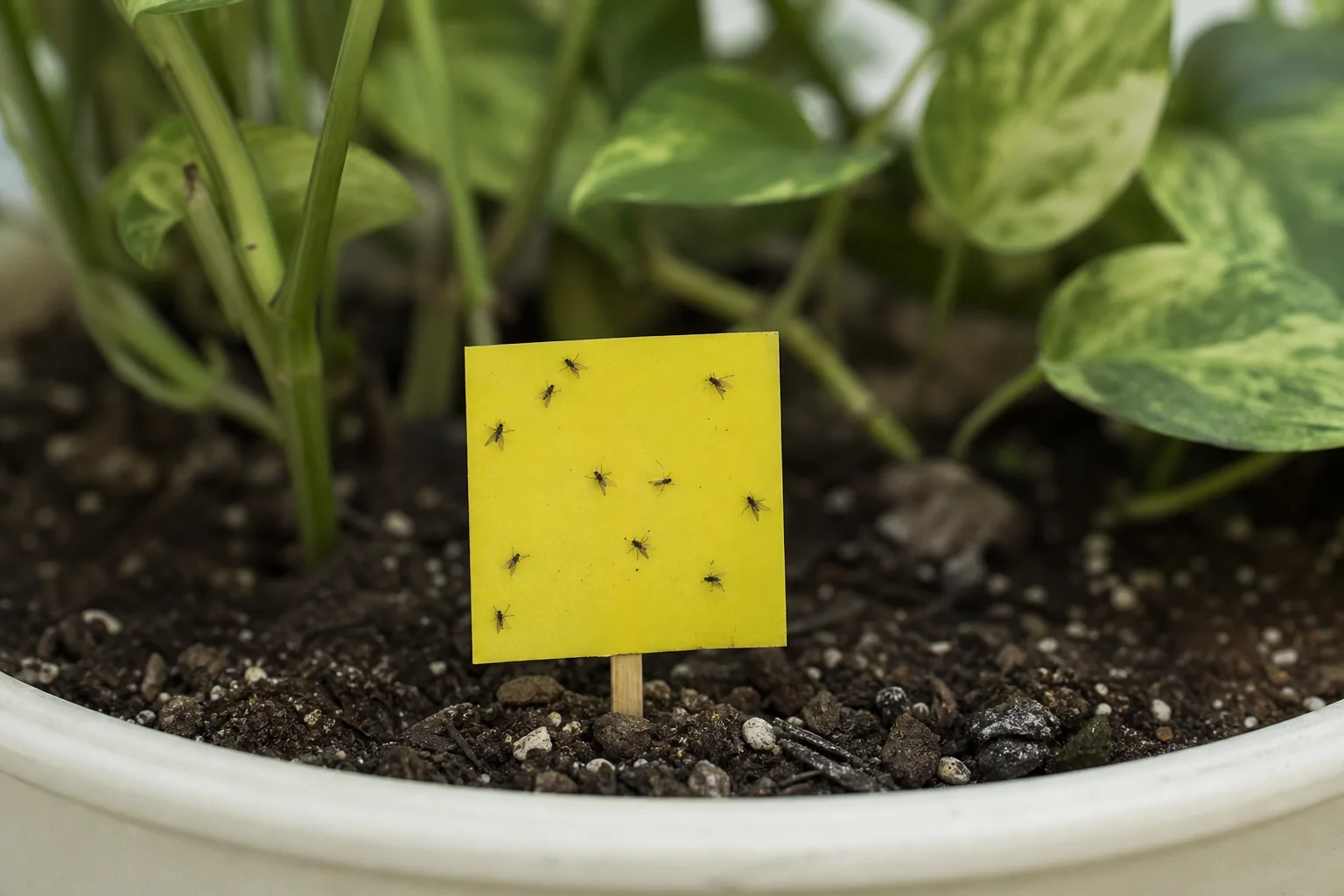
Place a small yellow sticky card on a stake so its lower edge sits just above the potting mix. Position one in each suspected pot rather than hanging a single trap high above the entire collection. Check it every few days with a magnifier or a phone camera’s macro setting.
- Several slender, dark flies on the card nearest one pot: that pot is a likely breeding source.
- Flies mainly in the kitchen but few on soil-level cards: inspect fruit, trash, recycling, and beverage residue.
- Flies mainly near plumbing: investigate drains or persistent leaks instead of treating the plants.
- No immediate catch: leave the card in place and disturb the soil gently during later checks; low adult activity can make a one-day test inconclusive.
Sticky traps are evidence and adult monitoring tools—not complete treatment. They capture some flying adults but do not reach eggs, larvae, or pupae in the potting mix. University of Minnesota Extension specifically advises against relying on sticky traps as the only fungus gnat management method. Review its houseplant pest guidance.
Safety: keep adhesive cards where children and pets cannot touch them, and prevent leaves from sticking to the surface.
Find the pot condition supporting repeat generations
Fungus gnats do not prove that the owner simply watered too often. Their larvae are associated with fungi, algae, decaying plant material, and other organic matter in moist growing media. The underlying cause may be watering frequency, but it can also be slow drainage or a mismatch between the plant, pot, mix, and indoor environment.
Run a moisture audit before changing care
- Check the mix below the surface instead of judging by color alone. A wooden skewer or finger can help reveal moisture deeper in the pot.
- Record how many days the root zone remains wet after a thorough watering.
- Confirm that the container has an open drainage hole and empty water from its saucer or cachepot.
- Look for compacted, decomposed, or peat-heavy mix that stays dense and wet.
- Compare pot size with root-ball size. Excess mix around a small root system can remain wet for a long time.
- Remove fallen leaves, dead flowers, and other decaying debris from the surface.
- Consider recent changes in light and temperature. A plant growing slowly in lower light generally uses water more slowly.
Do not impose the same drying rule on every species. A succulent may tolerate substantial drying, while a fern or other moisture-sensitive plant may be damaged by the same treatment. Watering frequency depends on species, light, temperature, humidity, container, drainage, and potting mix, as explained by Illinois Extension. Aim for the driest interval the individual plant tolerates without wilting or root injury—not an arbitrary number of dry days.
Decide whether this is a nuisance or part of a root problem
Most fungus gnat problems in established houseplants are primarily annoying. However, high larval populations can feed on fine roots, and consistently wet media can coincide with oxygen-starved or decaying roots. Plant decline therefore calls for a broader root and watering assessment rather than an assumption that the gnats alone caused every symptom.
Check for larvae without immediately unpotting the plant
Inspect the upper potting mix with a magnifier for translucent, threadlike larvae with black heads. Another monitoring option described by university extension programs is to place a raw potato slice against the soil, then inspect its underside after several days and discard it afterward. This can reveal larvae, but it is not a stand-alone control method.
When to inspect the root ball
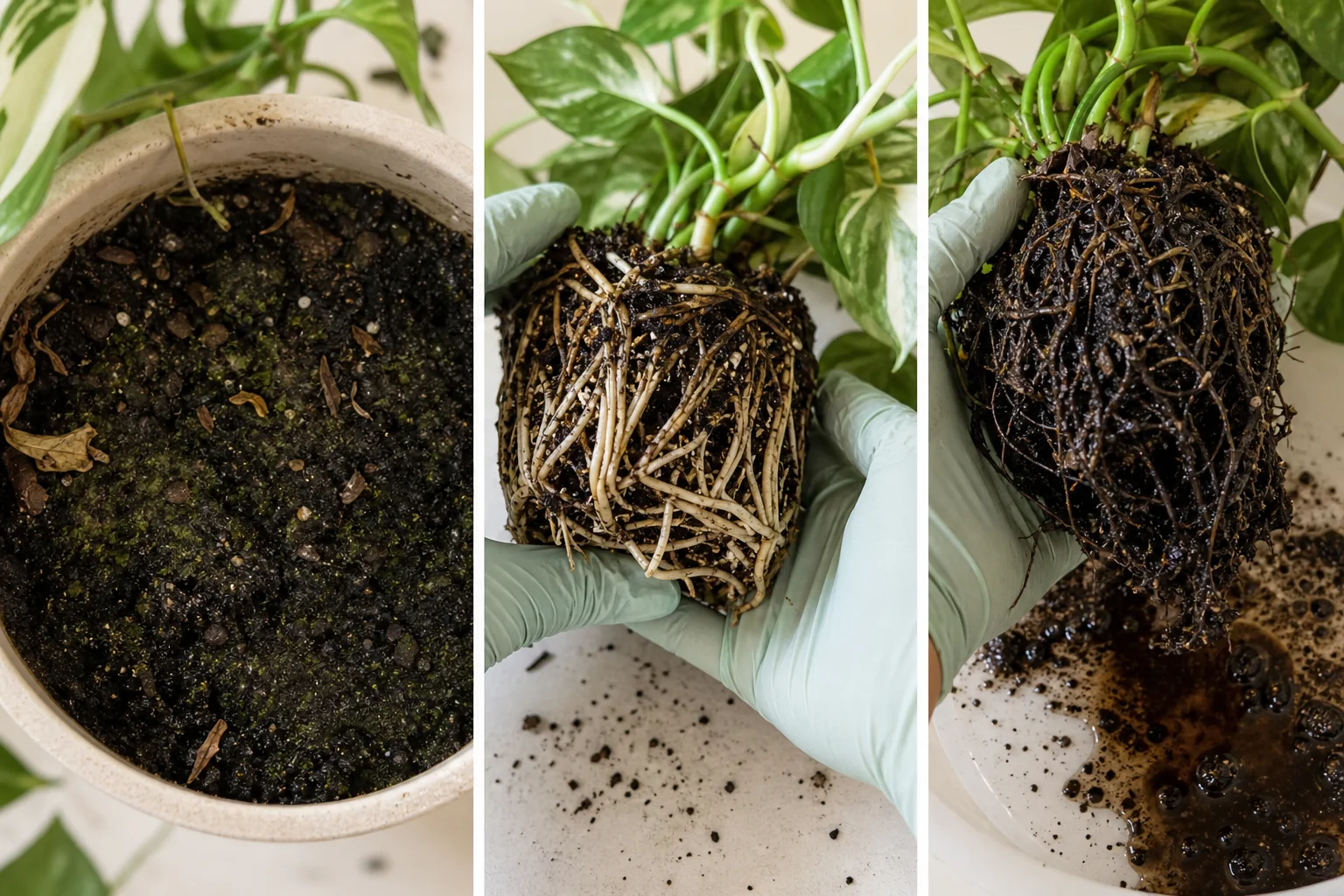
Consider sliding the plant from its pot if the mix remains saturated unusually long, smells sour, the plant wilts despite wet soil, growth has stalled, or leaves are yellowing while the stem base softens. Avoid disturbing a healthy-looking plant solely because a few adults appeared.
- Generally healthy roots: firm, resilient roots with active pale or white tips, allowing for species that naturally have darker roots.
- Concerning roots: limp, blackened or dark-brown roots, few healthy tips, or outer tissue that slips away when handled.
Dark roots are not enough for a certain diagnosis because natural root color varies. Penn State Extension notes that root decline can also resemble injury from watering extremes, excess fertilizer, or cold exposure. See its diagnostic cautions.
Break the cycle with separate adult and soil-stage actions
Use several compatible steps at the same time. Adult monitoring tells you whether the population is falling, while moisture and larval measures address the source.
1. Monitor and reduce adults
- Keep yellow sticky cards just above the soil in affected pots.
- Replace cards when dusty, crowded, or no longer sticky.
- Record catches by pot so you can find hidden sources and compare weekly trends.
- Isolate heavily affected new plants while you assess the rest of the collection.
2. Make the pot less favorable to larvae
- Adjust the next watering according to the plant’s actual moisture needs.
- Empty standing water and correct blocked drainage.
- Remove decaying plant debris and clean algae from saucers or cachepots.
- If the mix is degraded, compacted, sour-smelling, or poorly matched to the plant, repot into fresh, well-draining potting mix in a clean container.
- Do not automatically move the plant into a larger pot; excess wet mix can prolong the problem.
3. If needed, choose a labeled larval control
Some products containing Bacillus thuringiensis subspecies israelensis (Bti) are labeled for fly larvae in growing media. Beneficial nematodes such as Steinernema feltiae may also be sold for fungus gnat larvae. Availability, permitted sites, application methods, storage requirements, and repeat intervals vary.
Read the complete product label before buying or applying anything. Confirm that the exact product permits use against fungus gnats in indoor potted plants, follow its stated rate and interval, and observe all precautions for people, pets, edible plants, and treated areas. A different Bt subspecies intended for caterpillars is not interchangeable with Bti for fly larvae. UC Integrated Pest Management summarizes biological options while emphasizing temporary control and possible repeat applications. Read the UC IPM guidance.
Never improvise pesticide concentrations, combine products unless their labels allow it, or spray flying insects around a room as a substitute for treating the breeding source. The EPA explains that the label specifies where, how, and how much of a pesticide may be used. Review EPA label guidance.
Expect gradual improvement, not an overnight cure
A single intervention may miss insects protected in another life stage. At typical indoor temperatures, Colorado State University Extension reports that the fungus gnat cycle from egg to adult can be completed in roughly three to four weeks. Adults may therefore continue appearing after you install traps or change watering because larvae and pupae already in the pot are still developing.
- During the first week: use traps to identify the most active pots and correct drainage, standing water, and surface debris.
- Over the following weeks: compare trap counts rather than expecting immediate zero activity.
- If catches decline: maintain plant-appropriate watering and continue monitoring long enough to detect a rebound.
- If catches remain level or rise: look for an untreated pot, stored damp potting mix, a self-watering reservoir, propagation container, terrarium, or another moist organic source.
Success means fewer adults from week to week, potting mix that no longer stays unnecessarily saturated, and stable or improving plant growth. It does not require forcing a moisture-loving plant into drought.
Prevent the next outbreak and know when to get help
- Inspect new plants and consider monitoring them separately before grouping them with the collection.
- Store potting mix closed, dry, and off the ground rather than leaving an open bag exposed to moisture.
- Use clean containers and fresh indoor potting mix; avoid bringing garden soil indoors.
- Check drainage and saucers whenever you water.
- Adjust watering as light, temperature, and plant growth change through the year.
- Keep one or two monitoring cards near larger collections to catch a return early.
Seek a more detailed diagnosis when the insect does not match the slender fungus gnat profile, flies persist despite source correction, or the plant has extensive wilting, stem collapse, or root decay. Those symptoms may involve a separate care problem or disease that cannot be confirmed from the presence of flies—or from a photo—alone.
If you use the diagnosis tool, include a close photo of an adult on the sticky card, the soil surface, the whole plant, the drainage setup, and any roots you have already inspected. Those views are more useful together than a distant image of a fly in the room.
Not sure which tiny fly is in your plant?
Use the plant diagnosis tool with close photos of the insect, sticky trap, soil surface, drainage setup, and any visible root symptoms. The combined evidence can help separate fungus gnats from lookalikes and identify the care condition supporting them.
Diagnose the problemFrequently Asked Questions
How can I tell fungus gnats from fruit flies?
Fungus gnats are usually slender, dark, long-legged flies that stay near moist potting mix and make short, weak flights. Fruit or vinegar flies are more compact, commonly tan or light brown, and are usually concentrated around ripe fruit, fermenting residue, trash, or recycling. Red eyes can support a fruit-fly identification, but the breeding location is often the clearest clue.
Do yellow sticky traps get rid of fungus gnats?
They help capture and monitor flying adults, but they do not reach eggs, larvae, or pupae in the potting mix. Use them to identify active pots and track progress while also correcting moisture conditions and, when justified, using a larval control labeled for indoor potted plants.
Should I stop watering a plant with fungus gnats?
No. Allowing more drying can reduce favorable larval conditions, but the safe amount depends on the plant and potting mix. Check moisture below the surface and delay watering only within that species’ tolerance. Do not intentionally wilt a moisture-sensitive plant.
Do fungus gnats mean my houseplant has root rot?
No. They often occur in damp, organic growing media without causing serious plant damage. Root rot becomes a separate concern when wet soil is accompanied by persistent wilting, yellowing, stalled growth, a sour smell, stem softening, or dark, limp, deteriorating roots.
Should I repot every infested houseplant?
Not automatically. Repotting can stress a plant and is most useful when the mix is compacted, decomposed, contaminated, poorly draining, or associated with unhealthy roots. A stable plant in suitable mix may improve with corrected watering, sanitation, monitoring, and an appropriate labeled larval treatment.
How long does fungus gnat control take?
Expect progress over several weeks rather than after one treatment. At common indoor temperatures, a generation can develop in about three to four weeks, and adults may continue emerging from stages already present in the soil. Falling weekly sticky-trap counts are a better measure of progress than a single gnat-free day.
Sources & Further Reading
- Managing insects on indoor plants University of Minnesota Extension
- Fungus Gnats as Houseplant and Indoor Pests Colorado State University Extension
- Fungus Gnats UC Statewide Integrated Pest Management Program
- Flies in the Home Colorado State University Extension
- Watering Houseplants Illinois Extension
- Fungal Root Rots and Chemical Fungicide Use Penn State Extension
- Why Read Labels? United States Environmental Protection Agency