If you are wondering whether you have spider mites or a regular spider on a houseplant, do not diagnose from one thread alone. Spider mites become likely when fine webbing on leaf undersides appears together with pale stippling, bronzing, and clusters of tiny moving dots; an isolated web without plant injury is usually a reason to inspect and monitor rather than treat.
First, read the web's location and density
A web is a clue, not a complete diagnosis. Spider mites are tiny arachnids that usually colonize the undersides of leaves. Web-producing species may lay a fine silk layer close against the leaf surface, especially along veins, around petioles, in leaf folds, and where leaves meet stems.
Webbing that raises suspicion for spider mites
- Very fine, gauzy silk hugs the underside of a leaf rather than hanging freely in open space.
- Silk is concentrated around petioles, veins, leaf joints, or several neighboring leaves.
- Numerous tiny dots, shed skins, or bead-like eggs appear caught beneath the web when viewed with magnification.
- The webbing occurs on the same leaves that show pale speckling or discoloration.
Webbing more consistent with an ordinary spider
- Individual strands can be followed across open gaps between a leaf, pot, shelf, wall, or neighboring plant.
- A recognizable spider is present and is much larger than a barely visible mite.
- The web acts like an insect-catching structure rather than a close silk film spread over leaf tissue.
- The leaves beneath it remain normally colored and show no spreading stippling.
Ordinary spider webs vary, and old webs can collapse into messy tangles. The safest distinction is therefore not neat web versus messy web, but whether the silk is accompanied by a colony and characteristic feeding injury.
Look for stippling and bronzing on the leaves
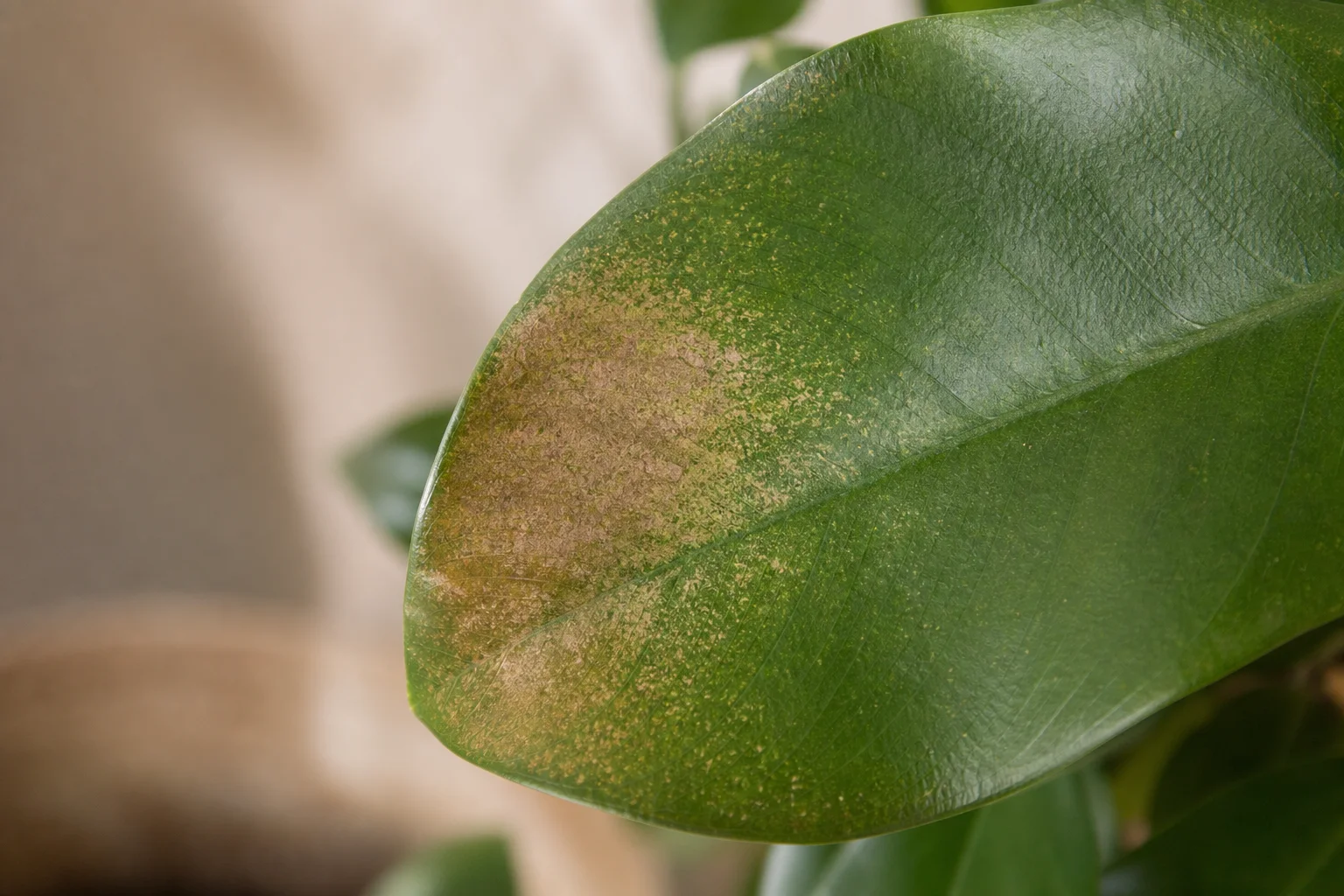
Spider mites damage foliage as they remove the contents of plant cells. Early injury often appears as many tiny pale, cream, or yellow points called stippling. The marks may begin in patches and then merge into a washed-out, gray-green, yellow, or bronze area as feeding continues.
How stippling differs from common lookalikes
- Spider-mite injury: numerous pinprick-sized pale dots distributed through the leaf tissue, often with stronger evidence on the underside.
- Normal variegation: stable, repeated blocks or patterns that also appear on healthy new leaves.
- Water spots or mineral residue: marks sitting on the surface that may partly wipe away with a damp cloth.
- Sun or heat injury: larger bleached or scorched patches, usually concentrated on the most exposed surface.
- Natural aging: broader, more even yellowing of an older leaf without webbing or moving colonies underneath.
Webbing plus stippling is much stronger evidence than either sign by itself. However, stippling can also be caused by other sap-feeding pests, so inspect the affected leaves before naming the culprit.
Inspect leaf undersides for mites and eggs
Turn over several leaves, including damaged leaves and apparently healthy leaves beside them. Use bright side lighting and, if possible, a 10× hand lens or a phone magnifier. Spider mites commonly gather near veins and the base of the leaf blade.
What to look for
- Moving dots: spider mites can look like slow-moving tan, yellow-green, brown, orange, or reddish specks to the unaided eye.
- Multiple individuals: a group of similar dots on damaged foliage is more meaningful than one unidentified speck.
- Eggs: under magnification, spider-mite eggs are round or spherical and may look translucent or cream-colored.
- Silk and cast skins: fine webbing may contain pale shed skins and debris from the colony.
Color alone is unreliable because spider-mite species and life stages vary. Likewise, a visible mite is not automatically a plant-feeding spider mite. Movement confined to the potting mix, without underside colonies or leaf injury, is not enough evidence to treat the foliage for spider mites.
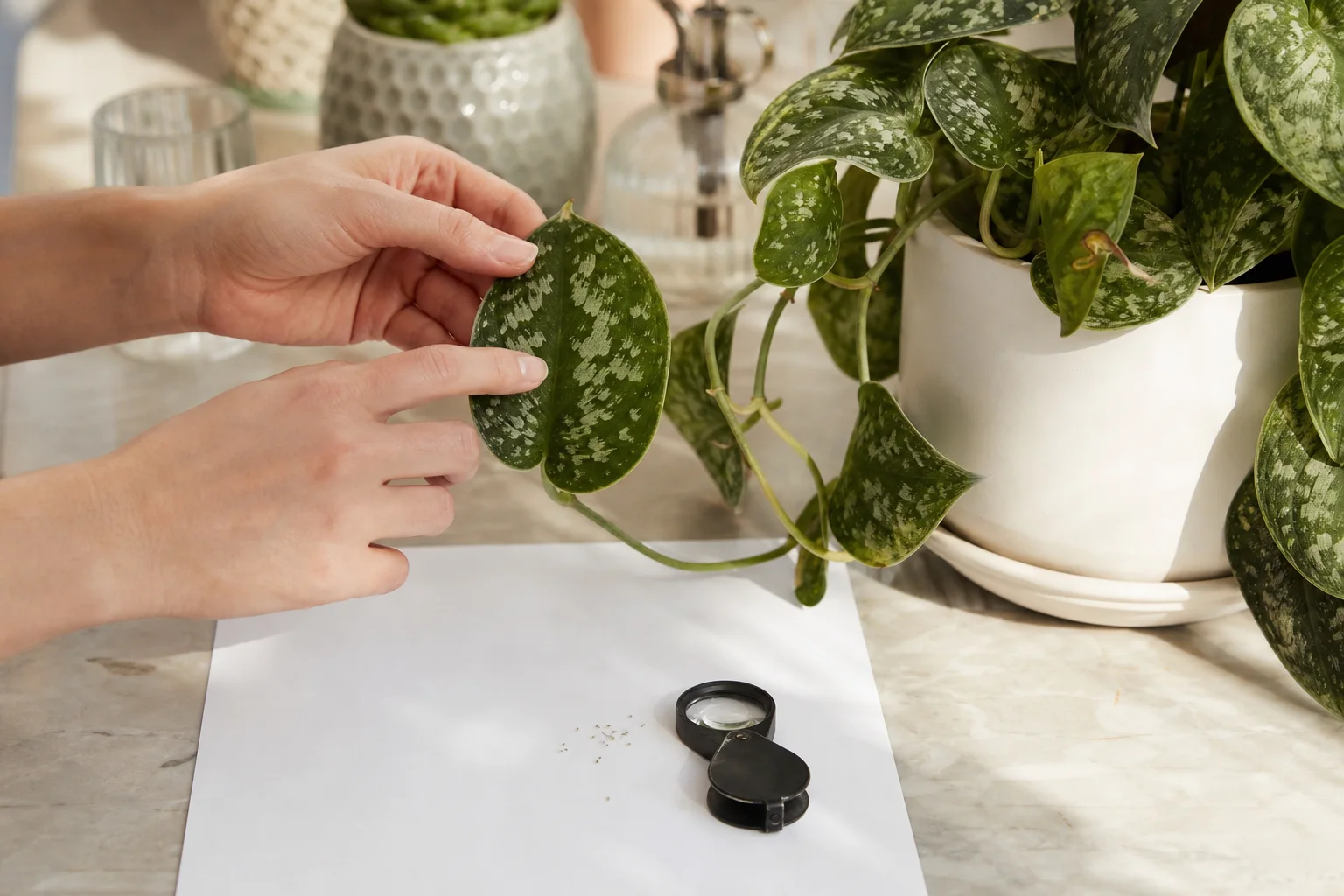
Do the white-paper shake test
This low-risk test helps reveal mites that are difficult to see against a leaf.
- Place a clean sheet of plain white paper or white card beneath a leaf with suspected stippling.
- Tap the leaf firmly several times or gently shake the foliage over the paper.
- Set the plant aside and watch the paper in bright light for about 20 seconds.
- Use a hand lens or phone magnifier to inspect any specks that begin moving.
- Repeat the test on leaves from two or three parts of the plant.
Dust, pollen, and potting-mix particles will remain still. Several tiny moving dots falling from stippled leaves increase the likelihood of mites, especially when you can also find underside webbing or eggs. A negative test does not completely rule them out when the population is small, so recheck suspicious leaves after a few days.
Do not rely on the paper test to identify the exact mite species. Its purpose is to add another piece of evidence, not to replace a magnified inspection or expert diagnosis.
Use an evidence ladder before deciding
Move from the weakest clue to the strongest combination rather than treating after the first suspicious thread.
- One isolated strand: weak evidence. Remove the strand, inspect the plant, and monitor.
- Fine webbing beneath leaves: possible spider mites. Check the same leaves for injury and moving dots.
- Fine webbing plus yellow stippling: moderate evidence. Perform the white-paper test and inspect with magnification.
- Webbing, stippling, and multiple moving dots on leaf undersides: strong evidence of an active mite problem.
- The same combination plus round eggs or widespread bronzing: treat the situation as a likely spider-mite infestation while avoiding claims about the exact species.
A recognizable spider in an open web, with no stippling and no underside colony, points away from spider mites. If desired, relocate the spider with a cup and card rather than spraying the plant.
When to monitor rather than treat
Monitor first when
- You see one or two threads but no pale stippling, bronzing, eggs, or moving dots.
- A visible ordinary spider occupies a web bridging the plant and its surroundings.
- The paper test is negative and the leaf marks wipe off or match stable variegation.
- Tiny organisms appear only in the potting mix and the foliage remains undamaged.
- The evidence comes from a single unclear photograph and cannot be confirmed on the plant.
Remove old webbing so that new silk is easier to detect. Photograph the same leaf, check neighboring plants, and repeat the underside inspection and paper test in three to five days. Avoid preventive pesticide use while the evidence remains inconclusive.
Act promptly when
- Several leaves have expanding stippling or bronzing.
- Fine webbing is spreading around leaf undersides, petioles, or growing tips.
- Repeated paper tests produce multiple moving dots.
- Magnification reveals colonies, eggs, and webbing on damaged tissue.
- Similar symptoms begin appearing on plants positioned nearby.
What to do when spider mites are likely
- Separate the plant. Move it away from other houseplants without brushing its foliage against them. Inspect nearby plants, especially where their leaves touched.
- Remove the worst material. Bag and discard heavily damaged leaves if the plant can tolerate pruning. Do not compost severely infested material indoors.
- Wash the foliage. Rinse manageable plants in a sink or shower, directing water toward leaf undersides. Support delicate leaves and avoid saturating potting mix that is already wet.
- Continue monitoring. Recheck leaf undersides and repeat the paper test every few days. Washing can reduce a population, but one rinse may not remove every mite or egg.
- Choose products carefully if needed. Consider a horticultural oil or insecticidal soap only when its label lists the target pest, the plant or use site, and indoor use where applicable. Test a small portion of the plant first and follow all label directions for coverage, intervals, ventilation, protective equipment, and keeping people and pets away.
Coverage of leaf undersides matters because that is where colonies commonly develop. Do not substitute concentrated dish detergent or combine untested homemade ingredients; these mixtures can injure foliage. Raising humidity may help some plants tolerate dry indoor conditions, but humidity alone should not be treated as a cure for an established infestation.
If the plant is extensively webbed, rapidly declining, or repeatedly reinfesting a valuable collection, discarding it may be safer and more practical than prolonged treatment.
Still unsure what the webbing means?
Upload clear photos of the whole plant, the damaged leaf surface, and several leaf undersides. The diagnostic tool can help organize the visible evidence, but confirm tiny pests with a magnifier or white-paper test before treating.
Diagnose My PlantFrequently Asked Questions
Does one strand of webbing mean my houseplant has spider mites?
No. One strand is weak evidence and may come from an ordinary spider or old webbing in the room. Inspect leaf undersides for colonies and check for yellow stippling before deciding whether treatment is justified.
Can spider mites be seen without a magnifying glass?
They may be visible as extremely small moving dots, but their body details and eggs are much easier to examine with a hand lens. The white-paper shake test can make movement easier to notice.
Are spider mites insects?
No. Spider mites are arachnids and are more closely related to spiders and ticks than to insects. Their small size and plant-feeding behavior are why they are commonly discussed with houseplant insect pests.
Can a regular spider damage my houseplant?
Ordinary house spiders primarily capture insects and other arthropods rather than feeding on plant tissue. Their web may be inconvenient, but its presence without stippling or a leaf-underside colony does not indicate spider-mite feeding.
What if I see tiny mites in the soil but no leaf damage?
Do not identify them as spider mites from their size alone. Check whether similar moving dots, eggs, webbing, and stippling occur on the leaves. If activity remains confined to the potting mix and the foliage is healthy, monitor instead of applying a spider-mite treatment.
Will misting or higher humidity eliminate spider mites?
No. Humidity adjustments may support a plant that prefers humid conditions, but they are not a dependable stand-alone treatment for an established infestation. Confirm the pest, wash the foliage where appropriate, continue monitoring, and use only properly labeled products if further control is needed.
Sources & Further Reading
- Spider Mites UC Statewide Integrated Pest Management Program
- Spider Mites Colorado State University Extension
- Managing Houseplant Pests Colorado State University Extension
- Twospotted Spider Mites in Home Gardens University of Minnesota Extension
- Mites in Home Gardens University of Maryland Extension
- Pesticide Safety Tips United States Environmental Protection Agency