Mealybugs hide beneath white wax and inside leaf joints, so a single wipe or spray often misses part of the population. This guide separates them from similar-looking pests and residue, then builds removal, product selection, and monitoring into one repeatable process.
Choose the right route before treating the white material
- White cottony clusters in leaf axils or stem joints: Isolate the plant immediately and begin the manual-removal route. Check nearby plants before returning them to their usual positions.
- Sticky leaves with black, wipeable growth: Inspect every leaf joint and nearby plant for mealybugs, scale, aphids, or whiteflies. Honeydew and sooty mold reveal sap-feeding activity but do not identify the pest by themselves.
- Hard brown or tan bumps attached to stems: Use a scale-insect route rather than assuming the bumps are mealybugs. Adult scale typically remains fixed beneath a firm covering.
- White residue wipes away, with no insect bodies or honeydew: Check for dried mineral deposits from hard water, fertilizer salts, or humidifier mist before using a pesticide.
- Cottony material fills hidden crevices, keeps returning, or surrounds roots: Separate the plant and assess its condition, value, and proximity to other plants. Intensive treatment may be possible, but discarding a severely infested plant can reduce collection-wide risk.
How mealybugs differ from scale, whiteflies, and residue
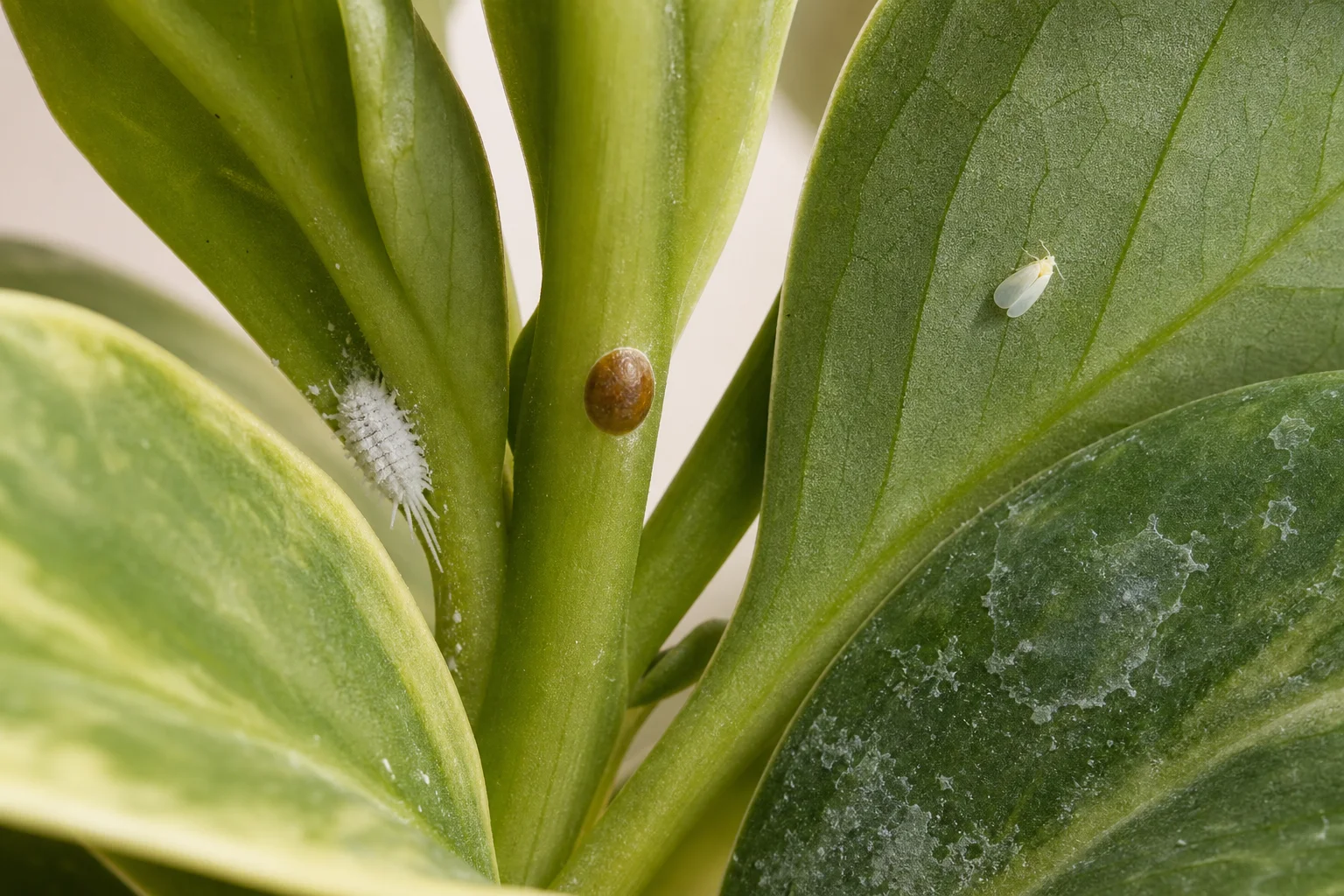
Aboveground mealybugs are soft, oval insects covered with powdery or filament-like white wax. They commonly gather where a leaf or petiole joins a stem, beneath overlapping leaf bases, around buds, and near the soil line. Some may move when disturbed. Cottony egg masses, sticky honeydew, ants, or black sooty mold strengthen the identification, although not every infestation produces all these signs.
Soft scale can also produce honeydew, but established insects resemble smooth brown, tan, or greenish bumps fixed to leaves and stems. Whiteflies look more like tiny white moths and usually flutter from foliage when the plant is disturbed. Their immature stages remain on leaf undersides, so flying adults are an important clue that the mealybug route is not the best fit.
Mineral residue is nonliving and usually forms irregular pale spots, rings, or crusts where water dried. It may dissolve or wipe away without revealing a segmented body underneath. Ordinary dust is more evenly distributed. Root mealybugs are different: white wax, insects, or egg material may appear along roots, inside the root ball, at drainage holes, or near the inner pot wall.
Set up containment and inspect every hiding place
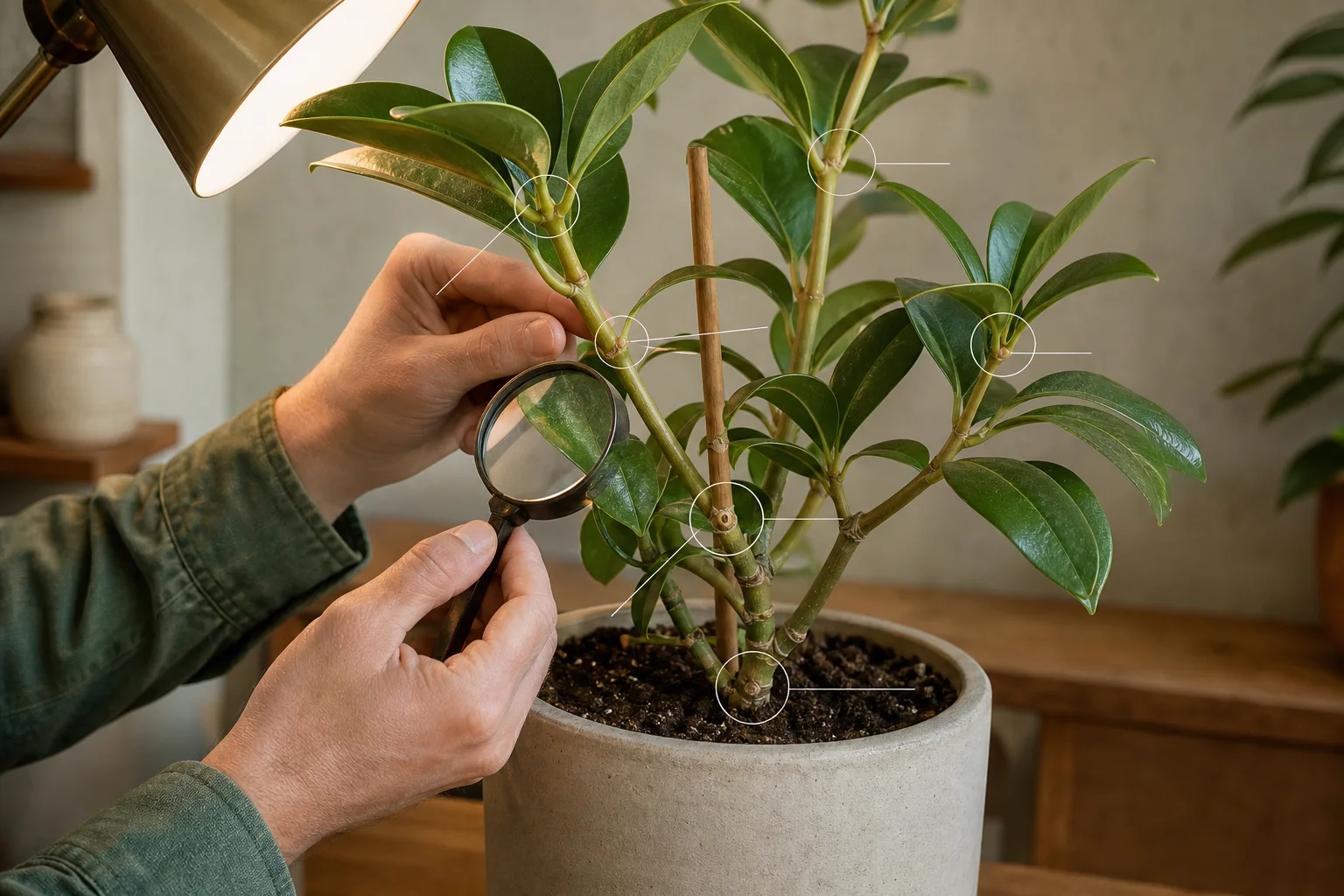
Move the affected plant to a separate, easy-to-clean location without brushing it against other plants. Isolation is temporary containment; it does not mean changing the plant’s normal light, temperature, or watering needs. Gather a bright inspection lamp, cotton swabs or tweezers, a soft damp cloth, clean pruning tools, paper towels, and a bag for infested debris.
Turn the pot slowly while inspecting the plant under bright light. Look along both sides of each stem, beneath leaves, around petiole bases, inside crowns and folded foliage, under clips and ties, and where stems touch a support. Examine the pot rim, saucer, decorative cachepot, stakes, and the soil surface because mealybugs and egg material may occur away from exposed leaves.
Check every plant that touched or closely bordered the affected specimen. Keep inspection tools and discarded material within the isolation area, and clean reusable tools before using them elsewhere. Avoid carrying an uncovered plant through a dense collection when another route is available.
Remove exposed insects without spreading them across the plant
- Start at the top and work downward. Hold a disposal bag or paper towel beneath the area so detached insects do not fall into another leaf joint or onto the floor.
- Lift off individuals and egg masses. Use tweezers, a swab, or the corner of a damp cloth. Replace or turn the material frequently rather than smearing wax and crushed insects across adjacent foliage.
- Prune selectively. Remove a flower stalk, badly crowded shoot, or leaf only when it contains numerous hidden insects and the plant can tolerate the loss. Place cut material directly into the bag.
- Rinse suitable plants if needed. A controlled stream of lukewarm water can dislodge exposed populations from sturdy foliage. Support stems, shield the potting mix, and skip forceful rinsing on fragile, hairy, tightly crowned, or easily bruised plants.
- Clean away honeydew. Wipe sticky foliage and nearby surfaces with water so later deposits are easier to recognize. Sooty mold grows on honeydew and may persist briefly even after pest numbers decline.
Physical removal is most useful for a small, accessible population. It does not reach insects inside tight sheaths, beneath dense wax, or around roots, which is why the follow-up inspections are part of the treatment rather than an optional extra.
Use a product only after passing the label check
For a few exposed mealybugs, extension guidance supports carefully dabbing the insects with isopropyl alcohol using a cotton swab. Keep it localized, away from flames, and test an inconspicuous part of the plant one to two days before broader use because alcohol can burn foliage. Plant response varies, and delicate surfaces may be injured even when another species tolerates the same approach.
Registered insecticidal soap, horticultural oil, neem-derived products, and other houseplant insecticides may suppress mealybugs when insects receive direct coverage. Adults are protected by wax and hidden sites, while younger crawlers are generally easier to contact. Do not substitute household dish detergent for a registered insecticidal soap; household formulations vary and can damage plants.
Five questions to answer on the package
- Is the pest listed? The directions should include mealybugs or a clearly applicable pest category.
- Is the plant or plant group permitted? Check both the treated species and any exclusions for sensitive foliage.
- Is indoor houseplant use permitted? An outdoor ornamental use does not automatically authorize use inside a home.
- What coverage and repeat interval are required? Follow the stated application rate, method, maximum frequency, and number of treatments rather than creating a stronger mixture.
- What precautions apply? Follow ventilation, protective equipment, storage, reentry, food-crop, child, pet, and disposal instructions.
Test soaps and oils on a small area and wait for the period stated by the label or, when none is provided, at least a day before treating more foliage. Avoid stacking alcohol, soap, oil, and other products in quick succession unless the labels specifically permit that sequence; accumulated contact injury can resemble pest damage.
Decide whether root or severe infestations justify intensive treatment
Do not disturb healthy roots merely because mealybugs were found on one leaf. Root inspection is more justified when cottony material appears at drainage holes or the soil line, aboveground insects repeatedly return despite careful removal, or the plant declines while its ordinary care conditions remain suitable. Slide the root ball out gently and examine its exterior, the inner pot wall, and accessible roots for insects and white wax.
If root mealybugs are confirmed, keep all soil and tools inside the containment area. Replacing the potting mix and washing soil from roots may reduce contaminated material, but the disturbance can be hard on species with brittle, fine, or rot-sensitive roots. Use a soil-applied pesticide only when its current label permits indoor use, the plant, the pest, and that application method.
Discarding can be the more proportionate choice when insects occupy most crevices or roots, the plant is already failing, repeated treatment has not reduced new activity, or many valuable plants remain exposed nearby. Seal the plant and potting mix before carrying them through the collection. Clean salvageable pots and tools separately, following local product and waste-disposal requirements.
Follow a timed removal and monitoring cycle
- Day 0: Isolate, complete the full inspection, remove visible insects and egg masses, clean honeydew, and apply a chosen treatment only if the plant and directions pass the safety checks.
- Days 3–4: Inspect new growth, leaf joints, the crown, soil line, pot rim, and nearby plants. Remove anything newly visible. This early check is especially useful after manual removal because previously hidden crawlers may move into exposed positions.
- Day 7: Repeat the detailed inspection. If using alcohol as a spot treatment, extension guidance commonly uses a weekly cycle after a tolerance test. For any registered pesticide, the product’s label—not this calendar—determines whether another application is permitted.
- Weeks 2–4: Continue at least weekly inspections and maintain isolation. Clean the surrounding surface and review adjacent plants rather than treating only the original specimen.
- Weeks 5–8: Keep checking weekly after the last live insect is found. Dense crowns, sheathing leaves, large specimens, and suspected root involvement may justify a longer observation period.
A practical success check is several consecutive inspections with no live insects, fresh cottony masses, or new honeydew in growing tips and protected crevices. The six-to-eight-week window is a cautious monitoring framework rather than a universal biological cutoff. Reassess identification, hidden roots, product coverage, or disposal if populations rebound, spread to multiple plants, or accompany continuing decline.
Confirm the Pest Before Starting Treatment
Whiteflies, scale, mineral deposits, and mealybugs require different next steps. Upload clear photos of the white material, affected leaf joints, and the whole plant to narrow the diagnosis before applying a product.
Diagnose My Houseplant PestFrequently Asked Questions
Can old mealybug damage disappear after treatment?
Yellowed, distorted, or scarred tissue may not return to its previous appearance. Judge progress by firmer new growth, reduced honeydew, and the absence of live insects at later inspections rather than expecting damaged leaves to become unmarked.
Can mealybugs remain on pots, stakes, or plant clips?
They can occur on pots, stakes, ties, saucers, and other protected surfaces associated with an infested plant. Inspect these items during every check. Clean reusable accessories before returning them to the collection, or discard inexpensive items containing inaccessible wax or egg material.
Should I fertilize a plant while it is being treated?
Avoid increasing fertilizer simply to force recovery. Excess nitrogen can encourage soft new growth that sap-feeding pests may favor. Maintain appropriate routine care and resume or adjust feeding according to the plant’s season, health, and normal requirements.
What should I do if ants are visiting the infested plant?
Ants may be attracted to mealybug honeydew. Remove the pest source, clean sticky surfaces, and inspect the route ants are using. Ant activity supports the presence of a honeydew producer but does not distinguish mealybugs from scale, aphids, or whiteflies.
Can I treat mealybugs on an edible indoor herb?
Use a pesticide only if the current label permits that edible crop, indoor application, and mealybugs. Follow harvest intervals and washing directions. If those uses are absent, rely on physical removal or replace the plant rather than applying an ornamental-only product.
How should I manage treatment around pets and children?
Keep them away from the isolation and application area according to label instructions, and store products securely. Do not assume a plant-derived treatment presents no risk. If a pet contacts or ingests a pesticide, contact a veterinarian or recognized animal poison-control service and keep the package available.
Sources & Further Reading
- Mealybugs UC Statewide Integrated Pest Management Program
- Houseplant Problems UC Statewide Integrated Pest Management Program
- How Do You Get Rid of Mealybugs on Houseplants? University of New Hampshire Extension
- Managing Houseplant Pests Colorado State University Extension
- Mealybugs on Indoor Plants University of Maryland Extension
- Introduction to Pesticide Labels U.S. Environmental Protection Agency