Aloe stores water in thick leaves, so a collapsing or leaning rosette signals that its structure, roots, or growing conditions need attention. This guide helps you distinguish moisture trouble from low light, temperature stress, pests, and harmless outward growth.
Rapid diagnosis: match the droop to the other signs
A drooping leaf does not identify the cause by itself. Begin with the newest center leaves, then compare them with the older outer leaves. Check leaf firmness, pot weight, moisture below the surface, odor, and how quickly the change appeared.
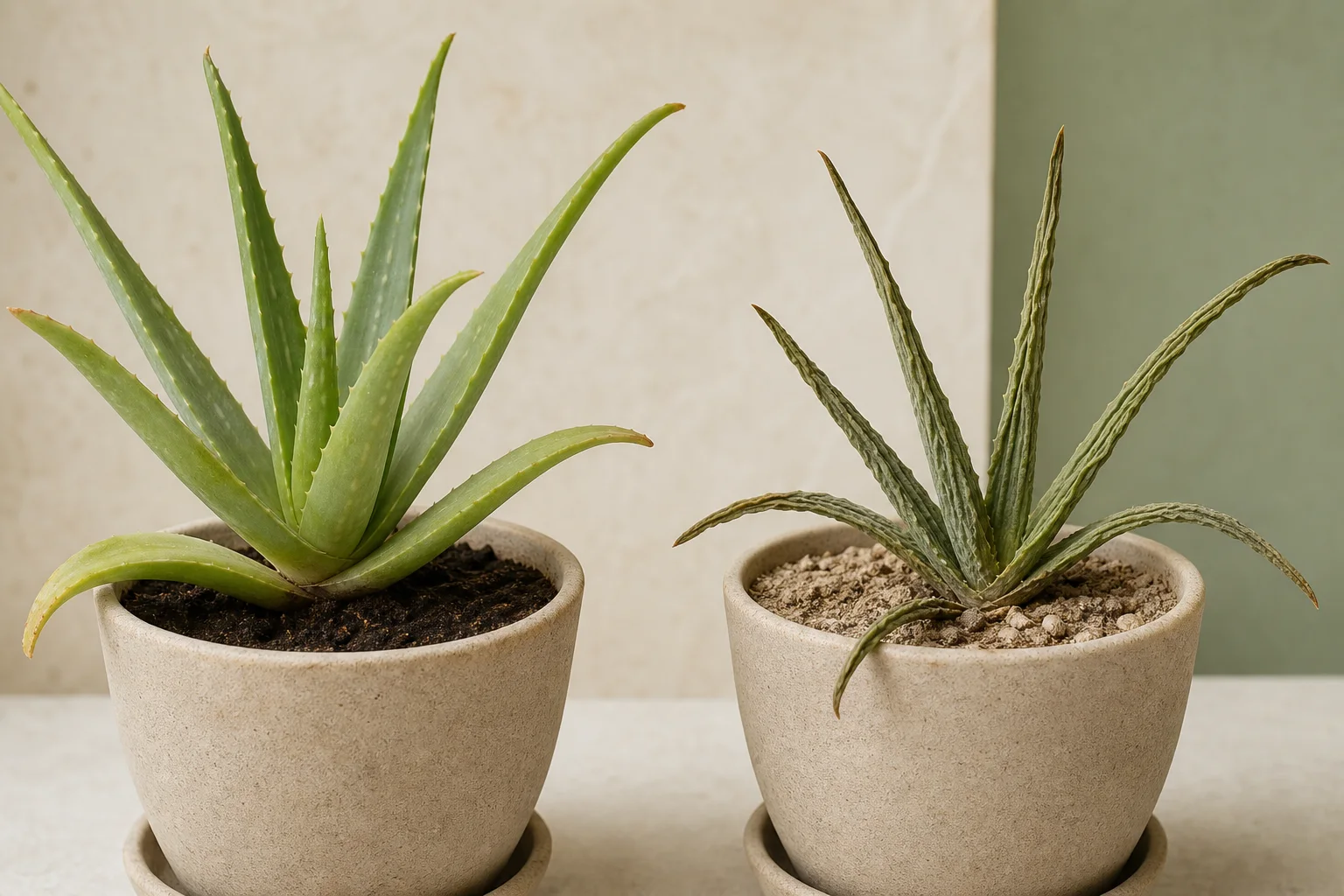
- Soft or translucent leaves, wet mix, and a loose or darkened base: excess moisture or root and crown damage is more likely.
- Thin, folded, or deeply wrinkled leaves with a very light pot: the root zone may have stayed dry too long.
- Long, pale, widely spaced leaves leaning toward the window: weak light may be producing stretched growth that cannot remain upright.
- Firm leaves but a tilted whole rosette: uneven light, crowded offsets, shallow planting, or a top-heavy plant may be responsible.
- Sudden limp, water-soaked, or dark tissue after a cold night: chilling injury is more plausible than a watering problem.
- Cottony deposits, sticky residue, or fixed brown bumps: inspect for mealybugs or scale, especially between tightly packed leaf bases.
Some mature outer leaves naturally angle outward. If those leaves remain plump and firm while the center produces compact new growth, the plant may not require corrective treatment.
Separate the causes that are easiest to confuse
Excess moisture versus underwatering
What overlaps: both can leave an aloe limp because damaged or dehydrated roots cannot maintain firm foliage.
Deciding clue: an overwatered aloe commonly feels soft while its mix remains damp; a thirsty aloe usually has thinner, less yielding wrinkles and a noticeably light pot. A dry-looking surface is not enough—mix can remain wet around the lower roots.
Wrong action to avoid: repeatedly watering a soft aloe in damp soil may accelerate root decline. Leaving a severely dehydrated aloe dry for several more weeks may cause additional root loss.
Low light versus insufficient water
What overlaps: leaves may bend outward in both situations.
Deciding clue: low-light growth develops gradually and is often elongated, pale, or directed toward the strongest light. Dehydration changes leaf thickness and usually coincides with dry mix throughout the pot.
Wrong action to avoid: extra watering cannot correct stretched growth and may keep a dimly lit pot wet for too long.
Root damage versus simple top-heaviness
What overlaps: the rosette may lean or feel unstable.
Deciding clue: healthy top-heavy plants retain firm leaves and a solid crown. Root trouble is more likely when the plant pulls away easily, the base feels soft, or roots are dark, hollow, or foul-smelling.
Wrong action to avoid: moving a healthy aloe into a much larger pot can create a greater volume of slowly drying mix.
Check water and roots without disturbing the plant too soon
If the mix is dry throughout
- Confirm dryness through a drainage hole or with a wooden skewer inserted deep into the mix.
- Water slowly until the entire root ball is moistened and surplus water exits the drainage holes.
- If water runs down a gap around a shrunken root ball, soak the pot briefly from below, then let it drain thoroughly.
- Do not leave the nursery pot standing inside a water-filled saucer or decorative cover.
Watch for leaves becoming less folded or wrinkled over the following days. Severely damaged leaves may not regain their former shape even when the roots resume functioning.
If the mix is still wet
- Stop watering and empty any trapped water from the saucer or outer pot.
- Move the aloe to bright light with normal room airflow, avoiding an abrupt shift into intense direct sun.
- Check that drainage holes are open. A pot without drainage should be replaced once the plant can be handled without causing further damage.
- If the crown is firm and there is no unpleasant odor, allow the mix to dry while monitoring the plant.
When root inspection is justified
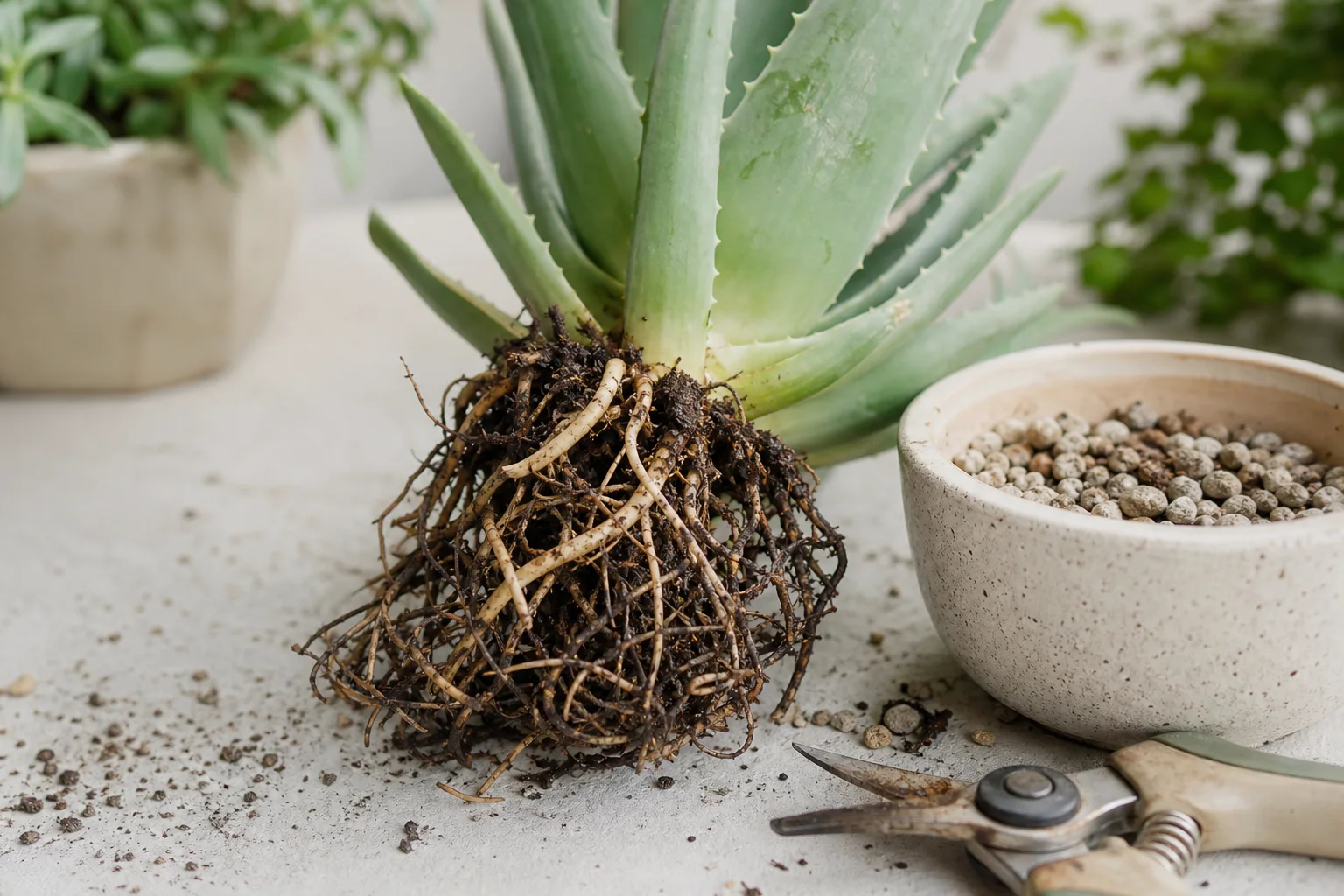
Slide the aloe from its pot if the mix remains wet unusually long, the base is soft or dark, the plant smells sour, or it continues collapsing despite suitable moisture. Healthy roots are generally firm; decayed roots may be brown or black, soft, hollow, or easy to strip.
Remove badly decayed tissue with a cleaned cutting tool. If firm roots and a sound crown remain, repot into a clean container with drainage and a dry, fast-draining succulent mix. Keep the pot only slightly wider than the remaining root system, let fresh cuts dry before exposing them to moisture, and resume watering cautiously rather than following a fixed calendar.
Correct light, temperature, and container problems
Increase useful light gradually
Aloe vera typically develops stronger, more compact leaves in bright conditions. Place it near a bright window and rotate the pot periodically if growth leans in one direction. If it has been in a dim room, increase direct sun in stages; a sudden move into intense outdoor or afternoon sun can cause bleached or brown patches.
Old stretched leaves are unlikely to shorten. Judge the adjustment by whether new center leaves emerge firmer, broader, and more upright.
Protect it from abrupt cold
Keep the plant away from frosty glass, cold drafts, and outdoor temperatures unsuitable for a tender aloe. Chilling injury often appears quickly as limp, discolored, or water-soaked tissue. Move the plant to a stable, bright location, keep damaged tissue dry, and wait until the extent of injury becomes clear before removing leaves.
Stabilize a healthy but leaning rosette
If the leaves and roots are firm, use a heavier pot with drainage rather than burying the crown. Position the root ball so the lowest leaves remain above the mix. Crowded, rooted offsets can be separated if they are pushing the parent plant off-center, but a slightly snug pot is usually easier to manage than an oversized one.
Rule out pests, physical damage, and normal leaf position
Inspect the crown, the sheltered spaces between leaves, the underside of the rosette, and the rim of the pot. Mealybugs resemble small cottony or waxy clusters and may leave sticky honeydew. Scale insects can look like fixed tan or brown bumps. A substantial infestation may weaken growth, but one bent leaf without visible pests is weak evidence of an insect problem.
Isolate an infested plant from nearby houseplants. Small visible populations can be removed manually. If using insecticidal soap, horticultural oil, or another houseplant product, select one labeled for the identified pest and plant type, test a limited area first, and follow the label. Spraying unidentified chemicals into the tightly packed crown may injure tissue or trap moisture.
Also look for a crease, split, pet damage, or a leaf compressed against a window. A physically bent aloe leaf does not usually straighten once its internal tissue has fractured. Leave it attached while it remains mostly green and firm, or remove it cleanly at the base if it becomes soft, extensively damaged, or begins to decay.
If the symptom pattern remains unclear, the AI plant diagnosis tool can help compare visible possibilities. Treat a photo result as a starting point and confirm it by checking moisture, smell, roots, and recent environmental changes.
Follow a staged recovery plan
Decision path
Mix dry and leaves wrinkled? Water thoroughly once and drain. Mix wet and leaves soft? withhold water and assess drainage. Base soft, dark, or odorous? inspect roots and crown. Leaves firm but elongated? improve light gradually. Whole plant firm but leaning? rotate, stabilize, and assess offsets. Cottony or shell-like pests present? isolate and identify before treating.
Today
- Record whether the change was sudden or gradual.
- Feel an older leaf and a center leaf separately.
- Check moisture below the surface and lift the pot to judge its weight.
- Empty standing water and inspect the crown for softness or pests.
- Move the aloe away from cold drafts without making a drastic light change.
Over the next 3–7 days
- Do not add water unless the root-zone evidence supports it.
- Monitor whether the center stays firm and whether collapse is spreading.
- Inspect roots if wet conditions, odor, or base deterioration continue.
- Keep a recently repotted aloe out of harsh sun while disturbed roots settle.
Over the next 2–4 weeks
- Base future watering on dryness and pot weight rather than a weekly schedule.
- Increase light gradually if new growth has been stretched.
- Watch the center for compact new leaves, the clearest sign that conditions are improving.
- Recheck sheltered leaf bases for pests and examine nearby plants if an infestation was found.
Know what recovery can and cannot change
Promising signs include a firm center, stable color, roots that remain solid, and compact new growth. Existing leaves may keep their wrinkles, bends, discoloration, or elongated shape, so progress is better judged by the crown and new leaves than by cosmetic repair of old tissue.
A leaf that is mushy, extensively translucent, blackened, or detached at the base is unlikely to become functional again. Remove decaying material with a clean blade while preserving firm green tissue. Avoid cutting several healthy leaves merely to make the rosette look balanced; aloe depends on its remaining foliage while roots recover.
If decay has reached most of the crown and no firm connection remains between the leaves and roots, saving the parent plant may be unrealistic. Healthy rooted offsets can sometimes be separated and potted individually in a fast-draining mix. If pests or decay are extensive, replacement may be more practical than repeated treatment, particularly when other plants are at risk.
Get a second opinion on your drooping aloe
Upload clear photos of the whole rosette, leaf bases, and potting mix to compare likely causes. Confirm any photo-based suggestion with hands-on moisture and root checks.
Diagnose My AloeFrequently Asked Questions
Should I water my aloe immediately when it droops?
Not until you check the mix below the surface. Water when the root zone is dry and the leaves are thinning or wrinkling. If the mix is damp and the leaves feel soft, adding more water may worsen poor root aeration or decay.
Can a drooping aloe stand upright again?
Leaves that are merely dehydrated may regain some firmness after the roots receive appropriate moisture. Stretched, sharply creased, or decayed leaves usually retain their damage. Look for stronger new growth rather than expecting every existing leaf to change shape.
Why is my aloe drooping even though the soil is dry?
The root ball may be so dry that water bypasses it, or roots may have been damaged by an earlier period of excess moisture. Confirm whether the interior is dry, water evenly if appropriate, and inspect the roots if the plant does not respond or its base feels unstable.
Why are my aloe leaves long and falling sideways?
Long, pale leaves that lean toward a window often indicate insufficient light. Move the plant into brighter conditions gradually and rotate it periodically. Existing stretched leaves may remain floppy, but new growth should become more compact if light was the main limitation.
Do I need to repot a leaning aloe?
Repot when drainage is poor, the mix is compacted, roots are unhealthy, or the rosette is physically unstable. Use a container with drainage that is only slightly larger than the root system. A larger volume of mix can remain wet longer than the plant needs.
What should I do if a pet chewed the drooping aloe?
The ASPCA lists Aloe vera as toxic to cats and dogs, with possible signs including vomiting, lethargy, and diarrhea. Move the plant out of reach and contact a veterinarian or a recognized animal poison-control service promptly for case-specific advice.
Sources & Further Reading
- Aloe Vera: Houseplant How-To South Dakota State University Extension
- Aloe, a Hardy Houseplant Penn State Extension
- Aloe Vera North Carolina Extension Gardener Plant Toolbox
- Winter Indoor Plant Problems University of Maryland Extension
- Watering Houseplants University of Connecticut Extension
- Houseplant Problems University of California Statewide Integrated Pest Management Program
- Toxic and Non-toxic Plants: Aloe ASPCA Animal Poison Control Center