Leaves are green in colour mainly because chlorophyll absorbs red and blue light more strongly than green light. More green wavelengths are reflected, scattered, or transmitted from the leaf, so green is the colour that reaches our eyes. You can explore this effect with a healthy leaf, white paper, and natural daylight, then check whether your plant's colour is normal or changing.
What makes a leaf look green?
Many cells inside a leaf contain chloroplasts, the structures where much of photosynthesis takes place. Within chloroplasts, chlorophyll a and chlorophyll b capture light energy used in the reactions that support sugar production.
Chlorophyll absorbs light especially strongly in parts of the blue and red regions of the visible spectrum. It absorbs green wavelengths less strongly, allowing more green light to leave the leaf through reflection, internal scattering, and transmission. Your eyes interpret that outgoing light as green.
This does not mean a leaf rejects or cannot use green light. Research indicates that green wavelengths can penetrate farther into leaf tissue than strongly absorbed red or blue wavelengths, where they may contribute to photosynthesis in deeper cells.
Gather materials and choose the right light
This observation takes about five minutes and does not require removing a leaf from the plant.
What you need
- A plant with a healthy, mature leaf
- A sheet of plain white paper
- Bright, indirect daylight near a window
- A small white flashlight, if available
- A phone camera or notebook for recording colour
Use daylight or a white lamp rather than a coloured grow light. Red, blue, or magenta lighting changes which wavelengths reach the leaf and can make its apparent colour misleading. Avoid placing a shade-grown plant in hot direct sun simply to perform the check.
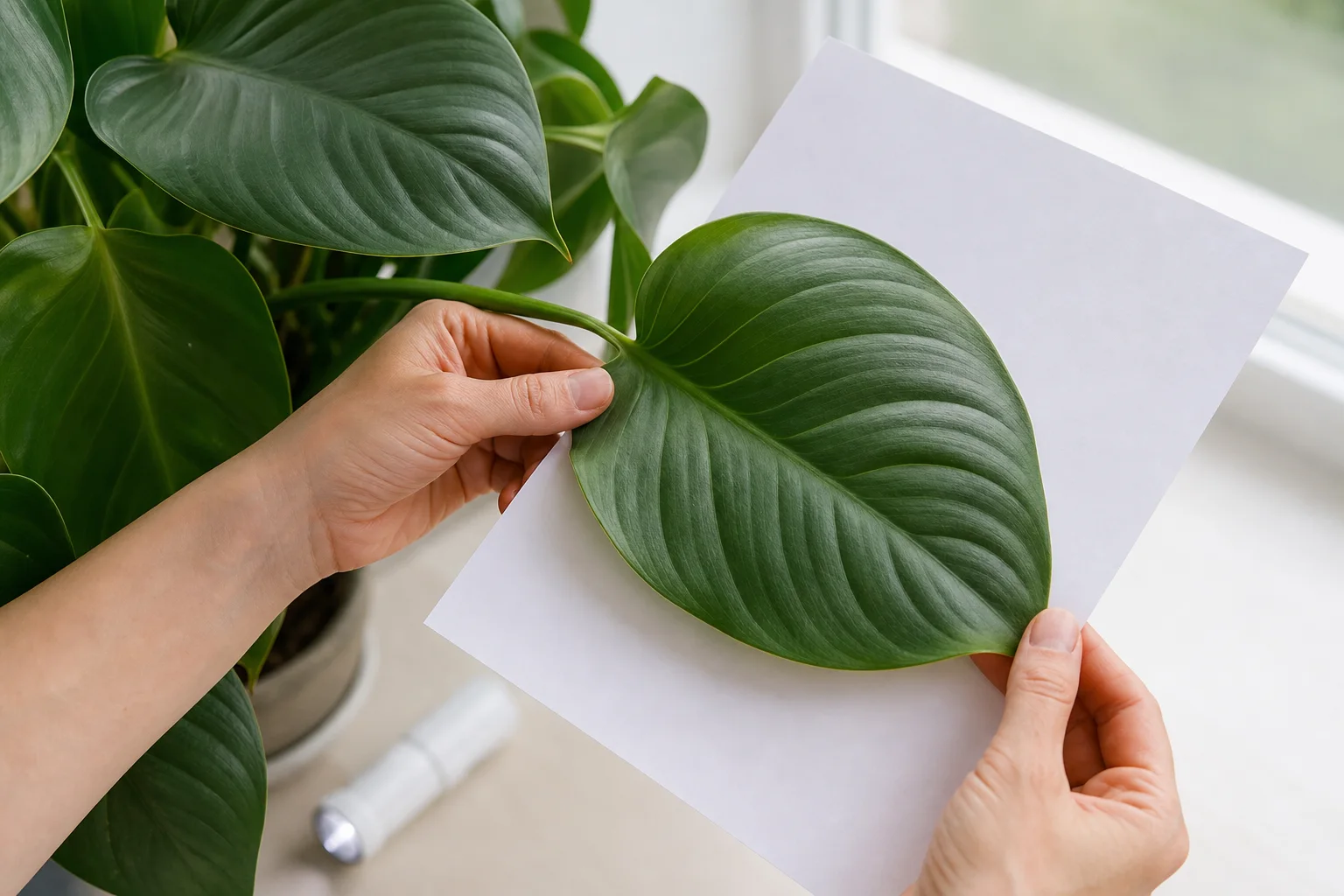
How to observe why a leaf appears green
- Choose a reference leaf. Select a mature leaf without yellow patches, scorch, pest damage, or heavy dust.
- View it against white paper. Place the paper behind the attached leaf and observe the upper surface in indirect daylight. The white background provides a neutral colour reference.
- Compare both surfaces. Without bending the petiole sharply, look at the upper and lower sides. Differences can be normal because leaf structure, wax, hairs, and chlorophyll distribution vary by species.
- Backlight the leaf. Hold the leaf between your eyes and a bright window, or shine a cool white flashlight through it briefly. Green light passing through the tissue may make thin areas appear luminous.
- Look for a pattern. Note whether the colour is even, naturally variegated, pale between veins, faded at the margins, or concentrated in isolated patches.
- Take a reference photo. Photograph the same leaf in neutral light. If its colour appears to be changing, repeat the photo from a similar angle in seven to fourteen days.
What your observations mean
Even, species-typical green
A stable colour that matches other mature leaves is usually a normal characteristic. Some species naturally produce lime-green foliage, while others have dark green, blue-green, or silvery leaves.
A greener upper surface
This is common in many plants. The upper leaf anatomy is often adapted to receive strong light, while the lower surface may be paler or have a different texture.
Green light visible through the leaf
This shows that some green wavelengths travel through the tissue. Other green light is scattered or reflected toward the viewer, contributing to the colour you see.
Colour that changes with the lamp
Leaf colour depends partly on the spectrum of the light source. Judge plant colour under neutral white light before deciding that a symptom is present.
Why some healthy leaves are not entirely green
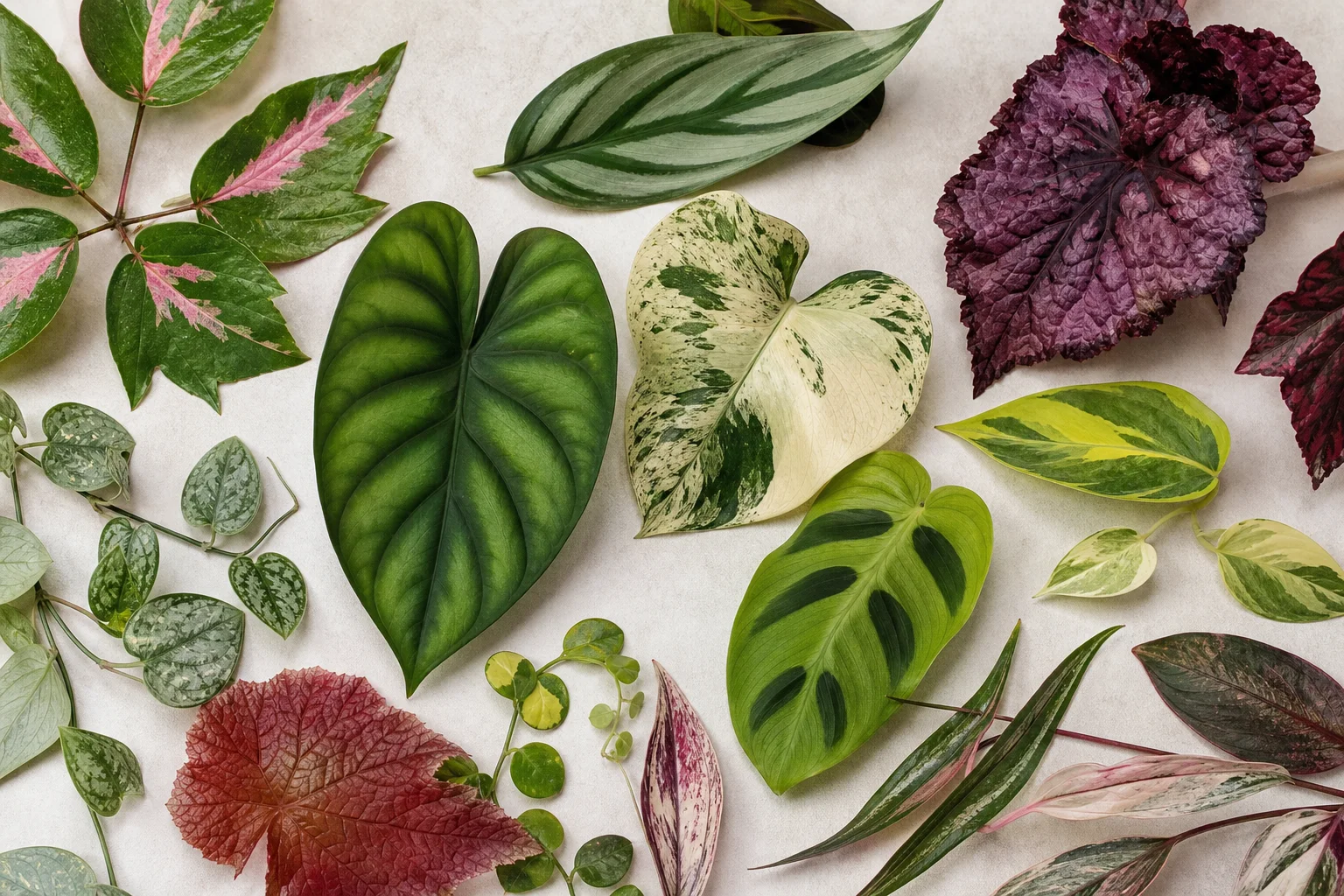
Leaves can contain carotenoids, anthocyanins, and other pigments in addition to chlorophyll. Their relative amounts, along with leaf anatomy and surface structures, can produce yellow, red, bronze, purple, silver, or patterned foliage.
- Variegated leaves: White, cream, yellow, or pink areas may contain less chlorophyll or appear pale because of structural effects. Compare the pattern with reliable images of the same cultivar.
- Red or purple leaves: Anthocyanins may mask some of the green appearance even when chlorophyll is present beneath or alongside them.
- New growth: Young leaves may emerge pale, bronze, red, or pink before developing their mature colour.
- Seasonal colour: In many deciduous plants, chlorophyll declines as leaves age in autumn, revealing or accompanying other pigments.
Non-green foliage is therefore not automatically unhealthy. The key distinction is whether the colour is expected for the species and remains stable, or appears as a new and progressing change.
How to check an unexpected loss of green colour
Yellowing caused by reduced chlorophyll is called chlorosis, but colour alone rarely identifies the cause. Watering problems, root damage, unsuitable pH, nutrient availability, light stress, temperature changes, pests, disease, and natural leaf aging can produce overlapping symptoms.
- Confirm that the colour is abnormal. Compare the plant with its established mature foliage and verified examples of the same species or cultivar.
- Identify which leaves changed first. Record whether symptoms began on old leaves, new growth, one side of the plant, or throughout the canopy.
- Check the potting mix before watering. Feel below the surface rather than judging by leaf colour alone. Note whether the mix is persistently wet, extremely dry, compacted, or slow to drain.
- Inspect both leaf surfaces. Look for insects, webbing, sticky residue, stippling, distorted growth, or sharply defined lesions.
- Review recent changes. Consider repotting, fertilizer use, relocation, cold exposure, heat from a vent, or a sudden increase in direct sun.
- Avoid treating every possibility at once. Blind fertilizing, frequent watering, and abrupt relocation can add stress or obscure the original pattern.
If several causes remain plausible, photographs of the whole plant, affected leaves, potting mix, and growing location can support a more useful diagnosis than a close-up of one leaf.
Monitor the plant and check your conclusion
Keep the plant in stable, species-appropriate conditions while you monitor it. Record watering, light changes, and symptom spread, and make one evidence-based adjustment at a time unless there is an urgent issue such as waterlogged mix, severe wilting, cold injury, or a substantial pest presence.
Signs your interpretation is reasonable
- The colour matches healthy reference leaves from the same plant or cultivar.
- Natural variegation repeats in a recognizable pattern rather than spreading like damage.
- No new discoloration, distortion, or leaf drop develops during the monitoring period.
- New growth approaches the expected mature colour as it unfolds and hardens.
Existing yellow or damaged tissue may retain its altered colour even after growing conditions improve, so assess progress mainly by whether symptoms stop expanding and whether subsequent growth looks appropriate. Seek local horticultural advice when discoloration continues despite careful basic checks, particularly for valuable outdoor plants where soil pH or nutrient testing may be useful.
Is Your Plant Losing Its Green Colour?
Upload clear photos of the whole plant and affected leaves to compare visible symptom patterns and explore possible causes. Include watering, light, and recent care changes because a photo by itself may not establish one diagnosis.
Diagnose a Leaf Colour ChangeFrequently Asked Questions
Why does chlorophyll appear green?
Chlorophyll absorbs blue and red wavelengths more strongly than much of the green region. Green light that is reflected, scattered, or transmitted by chlorophyll-containing leaf tissue reaches our eyes, creating the green appearance.
Do plants use green light for photosynthesis?
Yes. Leaves generally absorb green light less strongly than red or blue light, but some green wavelengths penetrate deeper into leaf tissue and can support photosynthesis in cells below the surface. It is therefore misleading to describe green light as entirely unused.
Are dark green leaves healthier than light green leaves?
Not necessarily. Genetics, leaf age, wax, hairs, pigment concentration, and adaptation to light can affect shade. Compare a plant with healthy examples of the same species and watch for changes rather than assuming one shade of green is ideal for every plant.
How can purple leaves photosynthesize?
Many purple leaves still contain chlorophyll, but anthocyanins and other pigments alter or mask the visible green colour. Photosynthetic capacity varies among species, cultivars, leaf ages, and growing conditions.
Does a yellow leaf have no chlorophyll?
A yellow leaf often has less visible chlorophyll, but the amount and distribution can vary. Yellowing may result from natural aging or from several environmental, root, nutritional, pest, or disease-related factors, so the pattern and care history should be checked before choosing a response.
Why do leaves look different under grow lights?
Objects can only reflect or transmit wavelengths supplied by the light source. Grow lights with strong red and blue output may make green foliage look dark, gray, or purple. Recheck the leaf under daylight or a neutral white lamp when assessing its colour.
Sources & Further Reading
- Photosynthesis Essays in Biochemistry via PubMed Central
- Green Light Drives Leaf Photosynthesis More Efficiently Than Red Light in Strong White Light Plant and Cell Physiology via PubMed
- Photosynthetic Physiology of Blue, Green, and Red Light Frontiers in Plant Science via PubMed Central
- Chlorosis University of Illinois Extension
- What Causes Leaves on My Houseplant to Turn Yellow or Brown and Drop Off? Iowa State University Extension and Outreach
- Where Do Fall Colors Come From? University of California Agriculture and Natural Resources